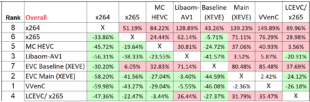
OK, I’ll say it. As far as I know, this is the first time any study has compared the quality and performance of codecs representing Essential Video Coding (EVC), Versatile Video Coding (VVC), and Low Complexity Enhancement Video Coding (LCEVC), as well as AV1, HEVC, and H.264. It’s not as exhaustive as I would like but the results should help …
Read More »Moscow State’s Dr. Dmitriy Vatolin Talks Codecs, Metrics, and Video Quality
Dr. Dmitriy Vatolin is the Head of the Moscow State University Graphics and Media Lab and one of my favorite colleagues in the streaming quality space. His group produces the Video Quality Measurement Tool (VQMT) that I use almost every day and publishes many codec studies that compare the latest and greatest with comprehensive, and real-world testing. Dr. Vatolin was …
Read More »How to Choose The Best Cloud-Based Per-Title Provider
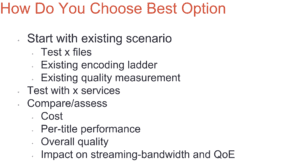
This video discusses how to choose the best cloud-based per-title provider. This was a talk I gave to the Streaming Video Alliance in late November 2021. The 23-minute presentation covers the following agenda with extensive examples. You’ll find the talk useful if you’re comparing per=title encoding features, particularly cloud-based, but also third-party options you can buy/lease and install and run …
Read More »Crafting the Ideal Encoding Ladder in Two Simple Steps
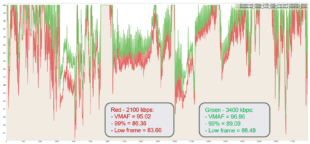
Companies attempting to formulate the ideal encoding ladder for specific videos or classes of content should incorporate both the harmonic mean VMAF score for overall quality and the percentile score to minimize transient quality issues. I’ve spent much of the last few weeks benchmarking H.264 and HEVC cloud-based per-title encoding capabilities like those available from AWS Elemental, Microsoft Azure, Brightcove, …
Read More »Choosing an x265 Preset: an ROI Analysis
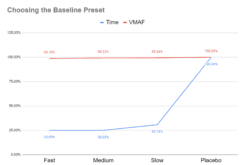
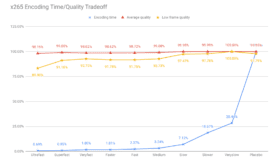
This post presents a return on investment view of choosing an x265 preset that delivers the optimal blend of encoding cost and storage and bandwidth savings. The first chart, x265 Encoding Time/Quality Tradeoff, is from a lesson in my course Streaming Media 101: Technical Onboarding for Streaming Media Professionals. Given the bandwidth and storage savings that higher-quality x265 presets deliver, …
Read More »Buyers Guide: Choosing a Software-Based Streaming Encoder for VOD
This entry-level article describes what an encoder is and how to choose one and focuses on VOD, not live. It was derived from a lesson in my Streaming Media 101 course, which teaches you the skills and techniques to succeed in a streaming media-related role. Click here for more details about the course. This article walks newbies through what an …
Read More »Choosing the Resolution for Lower Rungs on Your Encoding Ladder
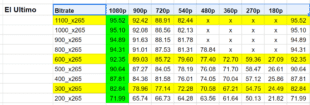
Your encoding ladder should include lower resolution rungs even if higher resolution rungs deliver better quality. This blog explains why. Several lessons in the online course Streaming Media 101: Technical Onboarding for Streaming Media Professionals focus on creating and configuring encoding ladders, including the Convex Hull technique discussed below. With advanced codecs like AV1 and HEVC, however, this analysis leads …
Read More »Which Codec Does YouTube Use, Part III
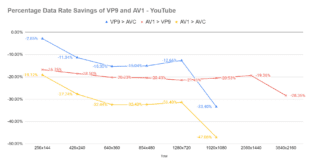
This article analyzes the codecs used by YouTube for 4K videos with millions of views, and the savings that AV1 and VP9 deliver over YouTube’s full encoding ladder. This is the third in a series of articles written about which codecs YouTube uses. The first covers which codecs YouTube uses for high-volume 1080p videos. The second covers the codecs used …
Read More »Formulate the Optimal Encoding Ladder with VMAF
This post describes how to formulate the optimal encoding ladder with VMAF. This analysis is excerpted from a lesson in the online course Streaming Media 101: Technical Onboarding for Streaming Media Professionals. I received the following question from a reader; it’s got such general applicability that I thought I would share my response. Question: We’re currently reviewing our ABR ladder …
Read More »Which Codec Does YouTube Use, Part Deux
YouTube encodes some videos using the AV1 and VP9 codecs. This post identifies the H.264 versions also created by YouTube for devices incompatible with VP9/AV1 for 1080p and larger videos. In a recent post, I explored which codecs YouTube used for videos ranging from a few hundred views to a few million. The conclusion was H.264 for videos with a …
Read More »
Streaming Learning Center Where Streaming Professionals Learn to Excel