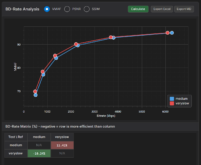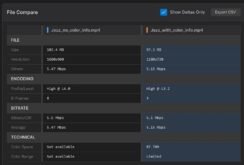
The new Portfolio feature in SLC Bitrate Explorer (SBE) version 2.0 aggregates BD-Rate and break-even results across multiple source files. This walkthrough covers the workflow from data entry to Excel export. Portfolios were NOT available in SBE version 1.0. If your version doesn’t show the portfolio buttons described below, you can upgrade to the new version below. This article was …
Read More »The Correct Way to Choose an x264 Preset, Part 2: Your Audience Changes the Answer
Here’s the question on the table. x264’s veryslow preset delivers better quality than the medium preset but takes roughly 4x longer to encode, boosting your encoding costs by a healthy 4x (2-3x if using a cloud encoder). Which is the right preset for you, medium or veryslow? Like everything else in streaming, it depends. By way of background, in a …
Read More »Capped CRF in a Multi-Codec World: FFmpeg and NVIDIA Implementations
I recently consulted with a company that was running capped CRF-type encoding across four codecs simultaneously: x264, VP9, NVIDIA H.264, and NVIDIA AV1. The first two were VOD encoding, the second two live. I was genuinely impressed by the sophistication and practicality of this video engineering setup, so I asked the client if I could share what they were doing. …
Read More »Per‑Title Before New Codecs: Fixing Your H.264 Baseline
Before comparing your existing H.264 encodes to HEVC, AV1, or any other advanced codec, you need a baseline you can trust. In practice, many codec efficiency claims collapse once you examine how inefficient the underlying H.264 ladder actually is. This article focuses on fixing that baseline before any codec comparison begins. Let’s take a step back. This is the second …
Read More »What I Learned About Deploying AV1 from Two Deployers
I recently hosted a Streaming Media Connect panel titled “Benefits and Trade-Offs of Adopting and Implementing Codecs.” The contributors were Hassene Tmar from Meta, Behnam Kakavand from Evolution Gaming, and analyst Alex Davies from Rethink TV. The most striking information was not about future codecs. It was about what AV1 deployment looks like when real companies actually do it. You …
Read More »When Metrics Don’t Mislead: Why VMAF Still Works for Neural Codecs—Sometimes
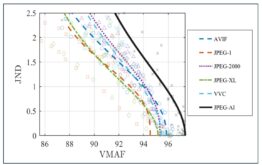
When I published When Metrics Mislead: Evaluating AI-Based Video Codecs Beyond VMAF earlier this year, the takeaway was blunt: traditional video quality metrics like PSNR, MS-SSIM, and VMAF simply can’t be trusted for AI-based codecs. My tests with Deep Render, and supporting research from JPEG AI and Microsoft’s MLCVQA project, showed that those metrics consistently underrate the perceived quality of …
Read More »Tuning Up Your H.264 and HEVC Streams
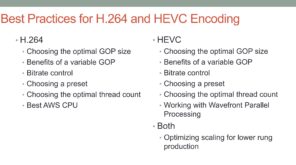
Dan Rayburn recently published the video and slides from my NAB Streaming Summit session, where I walked through real-world techniques to optimize x264 and x265 for quality and efficiency. No AI, no codecs from 2030, just practical optimizations that work today. If You’re Still Encoding with x264 and x265—Good You don’t need to jump to AV1 or VVC to get …
Read More »When Metrics Mislead: Evaluating AI-Based Video Codecs Beyond VMAF
Recently, I reviewed the Deep Render AI codec and noticed a substantial disconnect between subjective and objective results. Subjective testing showed Deep Render with a 45 percent BD-Rate advantage over SVT-AV1. VMAF showed just 3 percent. While subjective evaluation has always been the gold standard, this gap forced a more basic question: how accurate are traditional objective metrics when applied …
Read More »x265 and WPP: What’s Fast Isn’t Always Efficient
If you’re optimizing x265 for speed, enabling Wavefront Parallel Processing (WPP) looks like a no-brainer. Table 1 shows a staggering 7.3x improvement in encoding time. A 3:15 encode with WPP turns into a painful 23:51 without it. The quality penalty? Negligible. VMAF drops just 0.19, with the low-frame VMAF off by only 0.77 (low-frame is the lowest VMAF score of …
Read More »Evaluating DCVC-RT: A Real-Time Neural Video Codec That Delivers on Speed and Compression
Background Authors & Affiliations: Zhaoyang Jia and Linfeng Qi (USTC), Bin Li, Jiahao Li, Wenxuan Xie, Houqiang Li, and Yan Lu (Microsoft Research Asia). This project stems from an open-source effort initiated in late 2023, with code available on GitHub. The paper targets a long-standing obstacle for neural video codecs (NVCs): achieving real-time performance without sacrificing compression quality. Existing approaches …
Read More »
Streaming Learning Center Where Streaming Professionals Learn to Excel