 Streaming Learning Center Where Streaming Professionals Learn to Excel

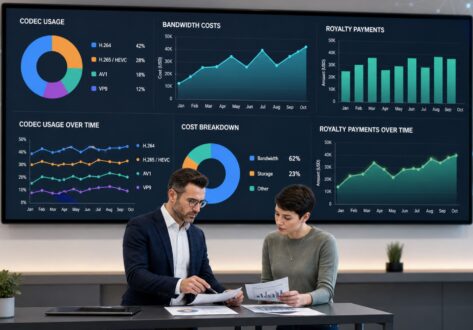
Codec Economics Advisory: Independent ROI Analysis for HEVC / AV1 / VP9 / VVC Deployment
A German court has put a per-subscriber number on codec royalties. Pools are signing licensees. Do you know your exposure?
In August 2026, the Munich I Regional Court published FRAND guidelines that calculated an aggregate codec royalty of €1.05 per month for a premium Netflix subscriber and rejected the argument that a licensed playback device protects the streaming service. Access Advance and Avanci Video are both signing content-side licensees. Disney+ dropped 4K and HDR in Germany after an InterDigital injunction.
Codec choice used to be an engineering call. Advanced codecs now come with royalties. Bandwidth savings, churn reduction, and premium-tier pricing can often offset that cost and more. But advanced codecs also introduce new costs: encoding, storage, and cache efficiency lost to running double the encoded files.
True ROI depends on how well both your baseline and new codec implementations are tuned, your actual encoding and delivery costs, which ladder rungs viewers consume, and your specific monetization model. Without a structured economic model, it is easy to overstate savings and understate total complexity.
Computing the net impact on profit and loss requires combining codec knowledge, finance, and royalty analysis. Few services have the internal expertise to run that calculation.
See how this played out for a streaming service in this case study.
Who This Is For
This productized advisory engagement is for streaming platforms, publishers, and broadcasters evaluating HEVC, AV1, VP9, or VVC who need to model impact across five core dimensions:
- Revenue Protection & Upside: Premium 4K/HDR tier pricing, ad yield, and churn reduction.
- Direct Costs: Encode, storage, CDN/delivery, and origin.
- Quality of Experience: Measured quality across devices and ladder rungs.
- Operational Complexity: Dual-ladder operations, cache behavior, and device coverage.
- Licensing & Royalty Risk: Patent pool obligations and major outside-pool licensors.
What You Provide
Before starting, we agree on a specific number of test files in genres and formats relevant to your service. You supply the source files and encoded test clips using your production encoders and settings, along with viewing analytics, subscriber/user metrics, and current cost structures. We provide a complete input checklist after the first call. No custom engineering work is required from your team to start.
What We Do
- Baseline Audit: Measure the actual efficiency of your current H.264 implementation.
- Candidate Audit: Measure the efficiency of your planned advanced codec using your encodes, not reference files.
- Delivery Economics: Model bandwidth savings and quality impact using your costs, ladder, and viewing data.
- Revenue & Cost Quantification: Quantify upside from premium tiers and ad inventory alongside fully loaded deployment costs, including encoding, storage, cache loss, and royalties.
- Royalty Exposure Analysis: Estimate obligations under relevant patent pools (Access Advance, Avanci Video) and flag major outside-pool patent holders.
- EBITDA Modeling: Consolidate inputs into an independent, finance-grade model with sensitivity analysis.
Engagement Options
Directional Assessment — $5,000
A rapid, first-pass read on whether the economics justify a full evaluation.
- Best for: Go / no-go decisions before committing to full diligence.
- Deliverables: Concise Findings Summary (5–7 pages) covering directional ROI, key cost drivers, royalty exposure range, and a 30-minute readout call.
- Turnaround: Typically 5 business days after receipt of all inputs.
Decision Record — $35,000
A full-scope engagement that produces a defensible, board-ready record for your licensing decision.
- Best for: Finance, legal, and executive approval of a major licensing commitment.
- Deliverables: Board-Ready Report (20–30 pages), a working Codec Economics Model in Excel with editable assumptions for sensitivity analysis, and a 60-minute executive readout.
- Turnaround: Typically 20–25 business days after receipt of all inputs.
Both prices assume one workflow (VOD or Live), one baseline encoder (usually H.264), one advanced codec (HEVC or AV1), and one content ladder. Additional codecs, workflows, or distinct content ladders are quoted after scoping.
About Jan Ozer
Your team knows your platform better than anyone. Their job is to build it, run it, and keep it reliable.
Codec ROI is a separate specialization sitting at the intersection of compression engineering, corporate finance, and patent licensing. Engineering evaluates codecs on technical merit; finance sees the bill after deployment. Rarely does anyone model the full P&L impact beforehand.
Jan Ozer has tested codecs since the 1990s and tracked codec licensing since 2008. He is one of the few compression experts who connects codec parameter selection directly to breakeven and EBITDA outcomes. He published the industry’s first structured comparison of Access Advance vs. Avanci Video licensing programs.
Ozer holds a J.D. and a CPA (non-practicing). He combines hands-on technical testing with licensing landscape analysis to produce financial models your C-suite can rely on.
Next Step
To evaluate a candidate codec and model its true impact on costs, revenue, viewer experience, and royalties, book a 20-minute scoping call to confirm inputs, scope, and timeline. Contact Jan at jan.ozer@streaminglearningcenter.com to get started, or complete the form below.
Selected Bibliography:
These recent articles and studies illustrate the kind of work and analysis that informs this engagement.
Codec Licensing
Disney+ Drops 4K and HDR in Germany After Second InterDigital Injunction, LinkedIn, July 2026.
Meta just took a patent license covering AV1 and VP9 from the Access Advance VDP Pool (hopefully) ending the AV1 is royalty-free narrative, LinkedIn, July 2026
All Encoding Decisions Are Economic Decisions. It’s Time to Start Treating Them Accordingly, Streaming Learning Center, April, 2026.
Independent Report Compares Codec Royalty Costs Across Two Major Licensing Pools, Streaming Media Magazine, April 2026.
H.264 Streaming Fees: What Changed, Who’s Affected, and What It Means, Streaming Media Magazine, March 2026.
Avanci Video Signs First Licensee and Publishes Rates, Streaming Media Magazine, February 2026
Beyond H.264. Why Codec Choices Now Carry Legal and Financial Risk, Streaming Learning Center, January, 2026
AV2 Arriving: What We Know, and What We Don’t Know, Streaming Media Magazine, September 2025.
Access Advance Reveals Royalty Rates for Video Streaming Services, Streaming Media Magazine, July 2025.
Codec Royalties on Content and the Jaws Moment, Streaming Learning Center, August 2023.
Encoding Techniques
Capped CRF in a Multi-Codec World: FFmpeg and NVIDIA Implementations, Streaming Learning Center, February 2026.
Lies, Damn Lies, and Estimated Bandwidth Savings, Streaming Learning Center, February 2026.
Per‑Title Before New Codecs: Fixing Your H.264 Baseline, Streaming Learning Center, January 2026
Codecs
The State of Streaming Codecs 2026, Streaming Media Magazine, March 2026
Comparing H.264, HEVC, VP9, and AV1 in SBE: From BD-Rate to Contextual ROI, Streaming Learning Center, May 2025.
Inside AV2: Architecture, Performance, and Adoption Outlook, Streaming Learning Center, October 2025.
Buyers’ Guide: Hardware Transcoders, Streaming Media Magazine, March 2025
