 Streaming Learning Center Where Streaming Professionals Learn to Excel

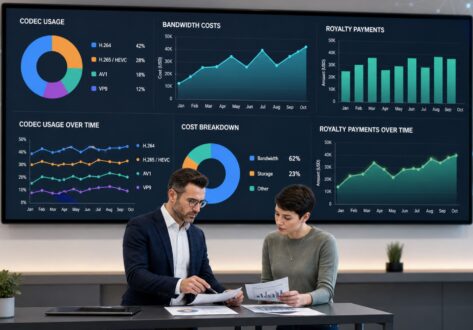
Are You Spending More Than You Need to Encode and Deliver Video?
Your encoding ladder determines both the quality of the videos your subscribers watch and how much you spend to deliver them. But many production ladders were designed years ago, inherited from previous platforms, or optimized for technical performance without measuring the economic return.
An Encoding Cost and Efficiency Review independently evaluates your current ladder construction and encoding parameters to determine whether configuration adjustments can reduce encoding and delivery costs without sacrificing viewer quality.
Questions the Analysis Answers
The analysis answers the core operational and financial questions:
- Top-Rung Bitrates: Are bitrates so high that you are wasting bandwidth delivering quality viewers cannot perceive?
- Ladder Spacing: Are spacing gaps degrading QoE for viewers on lower-bandwidth connections, particularly on mobile?
- Per-Title / Per-Category Encoding: Would your service benefit from custom ladders, for example, allocating more bits to high-motion sports than lower-complexity news or talk show content?
- Legacy Configurations: Are legacy settings (GOP size, presets, low-latency tuning) driving up delivery or compute costs without adding value?
- Compute ROI: At what viewing volume does a more compute-intensive encoding configuration produce positive ROI through bandwidth savings?
- Workload Alignment: Are you using the optimal encoder-codec combination for each VOD and live workflow?
- Actionable Roadmap: Which changes should you implement immediately, which require further testing, and which are not worth the effort?
The objective is not to find fault with existing workflows. It is to independently establish whether your current setup delivers the best practical combination of viewer quality, bandwidth efficiency, and operating cost.
How the Analysis Works
Before starting, we agree on a specific number of test files in genres and formats relevant to your service. You supply the source files and encoded test clips using your production encoders and settings. You also supply ancillary data such as encoding costs, viewing analytics, CDN delivery, and cost structure. I measure file quality and efficiency and compute the encoding and delivery cost baselines.
Then I systematically test alternative encoding parameters such as presets, GOP size, bitrate control techniques, single vs. multiple pass encoding, fixed vs. per-title encoding (if available), and others and compare them at equivalent perceptual quality.
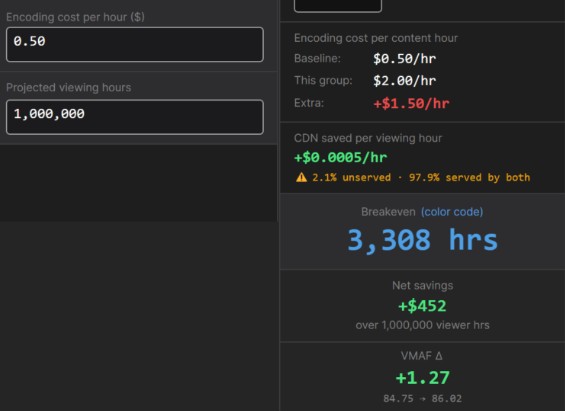
Finally, I apply your actual encoding and distribution costs and viewing volumes to calculate the true financial impact of each alternative, including the breakeven point for changes that increase compute cost to lower delivery bandwidth.
An optimization that costs more to encode is not necessarily more expensive. The analysis precisely calculates how many viewing hours are required for bandwidth savings to offset the additional encoding cost, and what you save beyond that point.
Sometimes, the veryslow preset is most cost-effective; sometimes the medium preset delivers the most efficient result. It all depends upon the types of videos you deliver, your encoding and delivery cost structure, and your distribution pattern. This is what we measure.
What You Get
You receive a prioritized, comprehensive analysis of your existing workflow and practical alternatives, including:
- Current encoding and ladder efficiency metrics
- Recommended configuration changes
- Measured quality and bitrate impact
- Incremental encoding costs vs. projected distribution savings
- Breakeven viewing-hour calculations and net financial impact
- Implementation priorities
- Executive summary translating technical findings into direct financial guidance for management
If the analysis reveals that your existing configuration is optimal, that is a valuable finding that validates your team’s strategy. If a different configuration delivers a superior financial result, you learn how much it matters over your typical file viewing patterns.
Engagement and Scoping
Fixed Investment: $6,000 per Encoder / Encoding Ladder
Each engagement is structured as a clear, fixed-scope evaluation tailored to your operational baseline.
- Base Scope Includes: One primary workflow (VOD or Live), one baseline encoder, one encoding ladder, and a representative set of source content.
- Deliverables: Full technical report, financial breakeven model based on your actual delivery metrics, executive summary, and a 45-minute findings readout call.
- Additional Ladders or Workloads: Quoted after the initial scoping discussion based on workflow complexity.
Why Bring In an Outside Expert
Your video engineering team knows your platform better than any consultant. Their job is to build it, operate it, keep it reliable, and respond when something breaks.
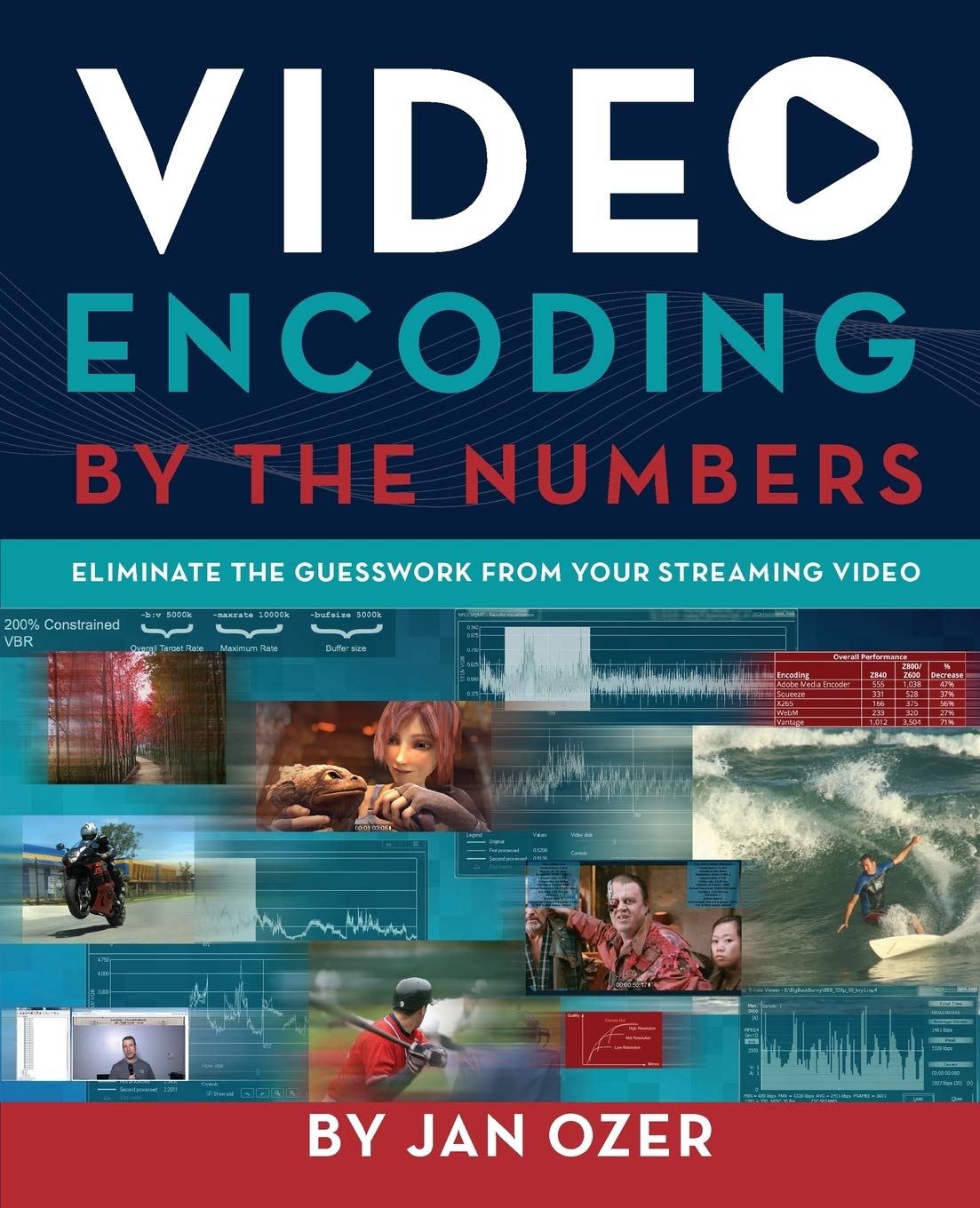 Encoding optimization requires a different specialization. Jan Ozer has worked with video compression since the 1990s, testing codecs and encoders, developing encoding ladders, and measuring the precise relationship between bitrate, quality, encoding cost, and delivery cost.
He authored the highly respected book Video Encoding by the Numbers and created Streaming Media 101, an encoding and streaming online course taken by over 700 streaming professionals. As a long-time contributing editor to Streaming Media, his codec and encoding research has been published and vetted by a technical industry audience. His work spans H.264, HEVC, VP9, AV1, VVC, CPU and GPU encoders, live and VOD workflows, and objective quality measurement, along with codec licensing and intellectual property considerations.
The goal is not to replace internal expertise. It is to provide targeted, independent analysis that your team may not have the time, tools, or mandate to perform internally.
Proven on a Production Streaming Service
The methodology behind this analysis has been developed and refined over years of encoding research and consulting, including economic analyses of VOD and live encoding optimization. Most recently, the analysis was applied during an engagement with a regional VOD and live streaming service, analyzing four production workflows across H.264, VP9, and AV1 using more than 6,500 test encodes.
The analysis identified multiple opportunities to reduce encoding and delivery costs, including one simple configuration change that the financial model projected would pay for the entire consulting engagement within a few months. You can download the case study here.
Who This Is For
This review is designed for streaming platforms, publishers, and broadcasters with meaningful encoding or CDN costs, particularly when:
- Your encoding ladder has not been independently reviewed recently
- Delivery costs represent a major operating expense
- Engineering is evaluating changes that trade higher compute costs for lower bandwidth
- You are preparing to deploy HEVC, AV1, VP9, 4K, or HDR
- Management wants independent validation of the current delivery architecture
Request an Encoding Cost and Efficiency Review
To discuss an Encoding Cost and Efficiency Review, book a 20-minute scoping call to confirm inputs, scope, and timeline. Contact Jan at jan.ozer@streaminglearningcenter.com to schedule a short scoping discussion or complete the form below.
Sales Contact
