Tag Archives: encoding review

AV1 Now Only 2X Slower Than x265

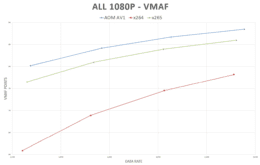
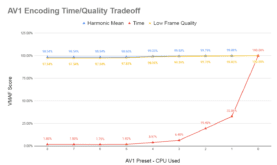
AV1 encoding on Windows is now only 2x slower than x265. With a properly compiled version of FFmpeg, encoding performance is slightly faster than the Alliance for Open Media’s encoder, though output quality is very slightly lower. Congrats to AOM for delivering on their promise to get encoding times down. Thanks for all the help I got from multiple sources, …

Read More »

Promising Initial Results with AV1 Testing

AV1 encoding is now only 2x slower than x265. See the latest results here.  I began testing AV1 early this week. Briefly, my tests involve 16 ten-second clips in four genres (movies, sports, animations, gaming) and an “other” category (music video, nature video). I’ve completed the first set of tests with FFmpeg 4.3, benchmarking x264, x265, and the latest version …

Read More »

Choosing the Optimal Preset for AV1 Encoding (and Other Questions)

AV1 encoding is now only 2x slower than x265. See the latest results here.  I’m comparing AV1 encoders for Streaming Media Magazine. I plan to include codecs from: The Alliance for Open Media (hopefully versions 1.0/2.0) Visionular Intel Mozilla (Mozilla is out – didn’t respond to my inquiry). If there are any other codecs that should be considered, please get …

Read More »

Lesson of the Week: Finding the Just Noticeable Difference in a MOS Score

Read More »

Lesson of the Week: Codecs are Not Generic

I discuss the bandwidth savings delivered by VP9 and HEVC over H264 in my course Streaming Media 101: Technical Onboarding for Streaming Media Professionals. I wanted to illustrate this with my own tests, so I used FFmpeg to encode H.264, HEVC, and VP9 output using about 25 short test files. This felt like a good time to discuss the difference …

Read More »

Tuning for Metrics: What About VMAF and VP9?

If you’re comparing codecs with video quality metrics, you should consider tuning for that metric. However, x264 and x265 don’t have a VMAF tuning option. According to my analysis, it appears that tuning for PSNR is the best option and one you should strongly consider. When working with VP9, there’s an additional complication; tuning for PSNR doesn’t appear to work.  …

Read More »

Encoding VP9 in FFmpeg: An Update

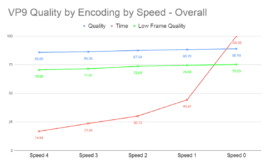
This is a long post only of interest to those attempting to optimize their VP9 encodes. The three key takeaways are 1) use the command script shown on the bottom of the page, 2) a speed setting of 2 offers the optimal quality/performance tradeoff, and 3) the row-mt setting improves performance significantly with zero quality loss when multiple unused cores …

Read More »

Choosing the Optimal CRF Value for Capped CRF Encoding

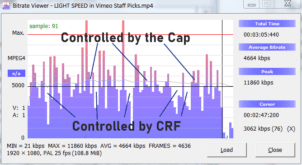
In a blog full of wonky compression articles, this could be the wonkiest article of all. If you’re not using capped CRF encoding, or considering the same, it’s almost certainly not of interest. If you are using capped CRF encoding (for constant rate factor), however, you almost certainly will find it interesting and perhaps even illuminating. A quick background note. …

Read More »

Using a Simple Wildcard Command in FFmpeg

Author’s note: This is a very simple automation technique for FFmpeg beginners. I’m sure there are much more efficient ways to script this project, but this represents my baby steps in FFmpeg automation. I recently started a consulting project that involved encoding multiple files to multiple CRF values to create rate-distortion curves and BD-Rate computations. I’m testing three codecs with …

Read More »

Open and Closed GOPs – All You Need to Know

This article defines open and closed GOPs, identifies why closed GOPs are better, and details how to produce closed GOPs in FFmpeg with x264 and x265. The level of testing and analysis detailed here is consistent with the instruction in my book, Learn to Produce Videos with FFmpeg In 30 Minutes or Less ($34.95), and my course, FFmpeg for Adaptive …

Read More »