I first encountered the line, “Anything worth doing is worth overdoing,” in the Robert Heinlein novel Time Enough for Love. I bring this up because this is my third recent article on GOP size, and I think I’m close to beating this topic into the ground. I’ll let you be the judge. To recount, I reported on testing in an …
Read More »Real-World Perspectives on Choosing the Optimal GOP Size
One of the most fundamental encoding decisions is the size of the Group of Pictures (GOP) or the frequency of I-frames within an encoded file. I-frames, also known as keyframes, are the starting points for groups of pictures, consisting of I-, B-, and P-frames. Traditionally, the GOP size is directed by adaptive bitrate streaming considerations, such as ensuring an I-frame …
Read More »Three Things to Know About 2-Pass x265 Encoding
Here are three things to know about 2-pass x265 encoding with FFmpeg. If you’re using -pass 1 and -pass 2 in your command string, it’s probably not working. You must use x265-params 0:pass=1 and then x265-params 0:pass=2 in the second pass. In the way we absolutely love about FFmpeg, there’s no error message if you use -pass 1/-pass 2; it …
Read More »What’s the Best Setting for x265 Two-Pass Encoding?
I’m running some 1-pass vs. 2-pass comparison testing with x265. Unlike with x264 (see tests here), there’s a substantial performance penalty for running 2-pass with minimal quality benefit. I tried the no-slow-firstpass=1 setting, which only accelerated two-pass by about 14%. Here are the results from a single test file. I don’t want to process them all if there’s a magic …
Read More »How Thread Count Impacts Video Encoding Quality, Throughput, and Cost
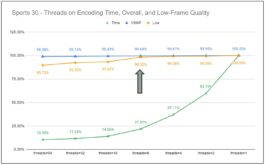
Learn how thread count impacts video quality, encoding speed, and costs in FFmpeg workflows. Master configurations for optimal production and testing results.
Read More »Choosing the Best Preset for Live Transcoding
When choosing a preset for VOD transcoding, it almost always makes sense to use the highest-quality preset, because any increase in encoding costs will typically be recouped via bandwidth savings delivered by the more efficient encoding. I covered that analysis in detail here. Note that this conclusion assumes that you deliver at a certain quality level and will boost the …
Read More »There are no codec comparisons. There are only codec implementation comparisons.
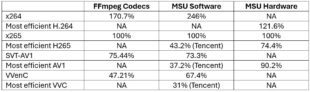
I was reminded of this recently as I prepared for a talk on AV1 readiness at the upcoming United Cloud Tech Talk. Though quality is only a single factor, I wanted to nail the quality comparisons for the talk, but didn’t have time to produce all the iterations myself. It’s been a while since I benchmarked H.264, HEVC, AV1, and …
Read More »JPEG AI Is Coming: What You Need to Know
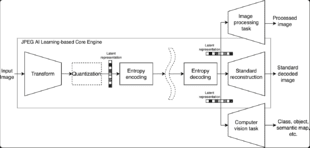
This article provides an overview of JPEG AI, which delivers superior compression efficiency and improved performance for AI tasks like object detection. JPEG AI is an initiative by the Joint Photographic Experts Group (JPEG) aimed at developing a learning-based image coding standard that uses machine learning techniques to achieve superior compression efficiency, offering a compact representation optimized for both human …
Read More »Enhancing Video Quality with Super-Resolution
Super-resolution techniques scale low-resolution videos to higher resolutions at high quality, and any video publisher with older, low-resolution footage should be aware of them. This article provides an overview of what super-resolution is, how it works, where to get it, and its limitations. Introduction to Super-Resolution As stated, super-resolution describes techniques used to scale lower resolutions to higher resolutions at …
Read More »The Quality Cost of Low-Latency Transcoding
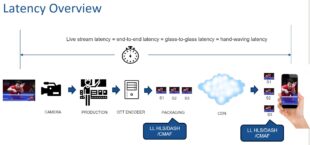
While low-latency transcoding sounds desirable, low-latency transcode settings can reduce quality and may not noticeably impact latency. Reducing latency has been a major focus for many live producers, and appropriately so, particularly for events that viewers can watch via other media, like sporting events available through satellite or cable TV. However, it’s important to understand that transcoding latency contributes minimally …
Read More »
Streaming Learning Center Where Streaming Professionals Learn to Excel