Tag Archives: content marketing

Microsoft MLVC: Interoperability, Power Realities, and the Neural Compression Patent Landscape

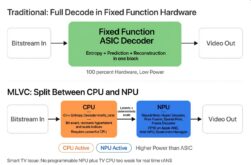
Microsoft recently open-sourced the Machine Learning Video Codec (MLVC) under the MIT License, publishing the codebase and model weights on GitHub, along with a technical announcement on the Microsoft Tech Community blog. The research paper, “MLVC: A Multi-platform Learned Video Codec for Real-World Deployment,” details the underlying architecture and makes this bold claim.  MLVC is the first neural video codec to …

Read More »

Wowza’s New Video Intelligence Framework – Interviews

Wowza just released the Video Intelligence Framework, or VIF. According to my article in Streaming Media Magazine, VIF is an AI inference module that runs inside Wowza Streaming Engine, rather than in a separate NVR/VMS stack or a cloud video AI service. It samples frames from streams already flowing through the engine, runs them through computer-vision models on a local …

Read More »

Cutting CDN Costs: A Conversation with CDN77

Recently, I sat down with Katerina “Kate” Dobnerova and Juraj Kacaba of CDN77 to discuss one of the largest recurring line items that every video publisher faces: CDN costs. By way of background, CDN77 is a video-focused global CDN that’s been in the market for 14 years, running a network with more than 300 Tbps of capacity and daily peaks …

Read More »

How Fast Will AV2 Deploy?: Ask Joe Sixpack

The AV2 spec went final in late May 2026, AOMedia announced it on June 9, and VeriSilicon had a decode IP core out within about two weeks. An AOMedia member survey reports that 53% of respondents plan to adopt AV2 within a year and 88% within two years. Over the next several months, expect a steady stream of AV2 support …

Read More »

CMSD-MQA: Carrying Quality Scores Through the Live Streaming Chain

I’ve been tracking CMSD-MQA for a while now. Briefly, Common Media Server Data for Media Quality Assessment (CMSD-MQA) is a draft SVTA standard that defines how video quality scores like VMAF, PSNR, and SSIM, generated at the encoder, can be carried downstream through the delivery chain as standardized metadata, giving packagers, origin shields, and monitoring systems actionable quality information without …

Read More »

Broadpeak Debuts “Best of Both Worlds” Multi-Package Multiview

I recently interviewed Damien Sterkers, VP of Products and Solutions Marketing at Broadpeak, to discuss the company’s new multiview solution for live streaming. Briefly, Broadpeak has developed an innovative server-side approach that delivers the best of both worlds: the universal device compatibility of server-side multiview without the massive encoding costs that approach typically requires. You can watch the video on …

Read More »

The Next Big Feature in Live Streaming: VMAF-Driven Bitrate Control

For most of the live encoding era, the operator’s main job was picking a bitrate. You’d set a target, the encoder would hit it, and quality was whatever came out the other end. Simple content looked great. Complex content looked terrible. The encoder didn’t care because you told it to deliver bits, not quality. Then came a generation of smarter …

Read More »

David Ronca Details VCAT Beta 4.0 with VVC Decode

On February 12, I interviewed David Ronca, formerly of Netflix and Meta, now RoncaTech, about the latest Beta version of his Video Codec Acid Test, or VCAT, which now includes VVC decode courtesy of Fraunhofer’s open-source VVeC decoder. The interview is available here on YouTube. Here’s an overview of the highlights we covered, with timestamps for the video. To get …

Read More »

Netflix’s Masterclass: Engineering Live Streaming at Scale

As a technologist and part-time couch potato, I appreciate Netflix on many levels. During the evening hours, it’s the creativity and breathtaking beauty of its productions. During working hours, it’s their technical contributions, like per-title encoding and VMAF, and their development and promotion of AV1. Unlike other publishers (cough, cough, Amazon), Netflix has always been amazingly gracious in sharing the …

Read More »

Deep Render and the Streaming Learning Center: A Sustained Visibility and Validation Campaign

Deep Render entered 2024 with real technical progress on its AI-based codec. The team had a working model, encoding and decoding live in FFmpeg and VLC, published research, funding, and a belief that AI-based compression represented a step change rather than an academic experiment. What they lacked was sustained visibility with streaming professionals who make codec decisions. The gap was …

Read More »