 Streaming Learning Center Where Streaming Professionals Learn to Excel

Related Articles


I recently interviewed Damien Sterkers, VP of Products and Solutions Marketing at Broadpeak, to discuss the company’s new multiview solution for live streaming. Briefly, Broadpeak has developed an innovative server-side approach that delivers the best of both worlds: the universal device compatibility of server-side multiview without the massive encoding costs that approach typically requires. You can watch the video on YouTube here; in this article, I summarize our conversation.
About Broadpeak
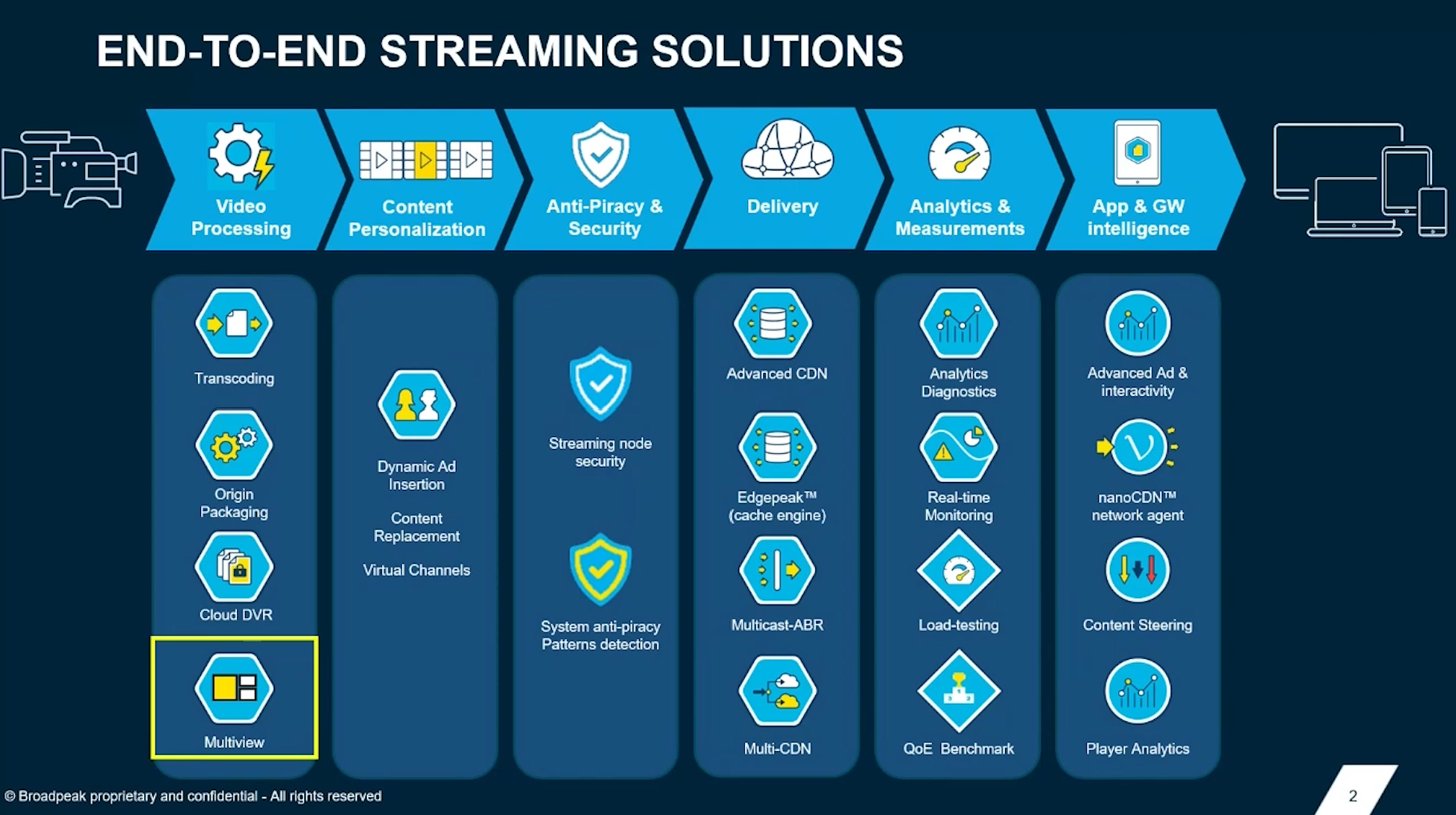
We started by describing Broadpeak, which is a France-based streaming technology company founded in 2010, with roughly 300 employees and offices around the globe. As shown in Figure 1, the company offers end-to-end video streaming solutions spanning video processing, content personalization, anti-piracy and security, delivery, analytics, and app intelligence.
Sterkers noted that Broadpeak is perhaps best known for delivery, and in particular for its multicast capability — “the ability to deliver live events in multicast, meaning only one stream for everyone. It’s very helpful when we have massive audiences.” The company has also built a strong reputation in dynamic ad insertion and origin packaging, serving major operators including Deutsche Telekom and Charter. More broadly, he said, “We’re known for being very present with our customers. We really follow them through their journey until they get their services delivered to the end users.”
Multiview is a natural extension of Broadpeak’s existing video processing work. “We’ve been deploying origin packagers and cloud DVR for quite a bit of time now, probably over ten years,” Sterkers said, “and now we’re proposing this multiview solution, which is an extension of what we’re proposing on the origin packaging process.” It also draws on the manifest-manipulation know-how built over years of content personalization and ad insertion work. The solution is available as licensed software, as a SaaS offering on Broadpeak’s proprietary platform, or as a fully managed service with 24/7 operator support.
Contents
About Multiview
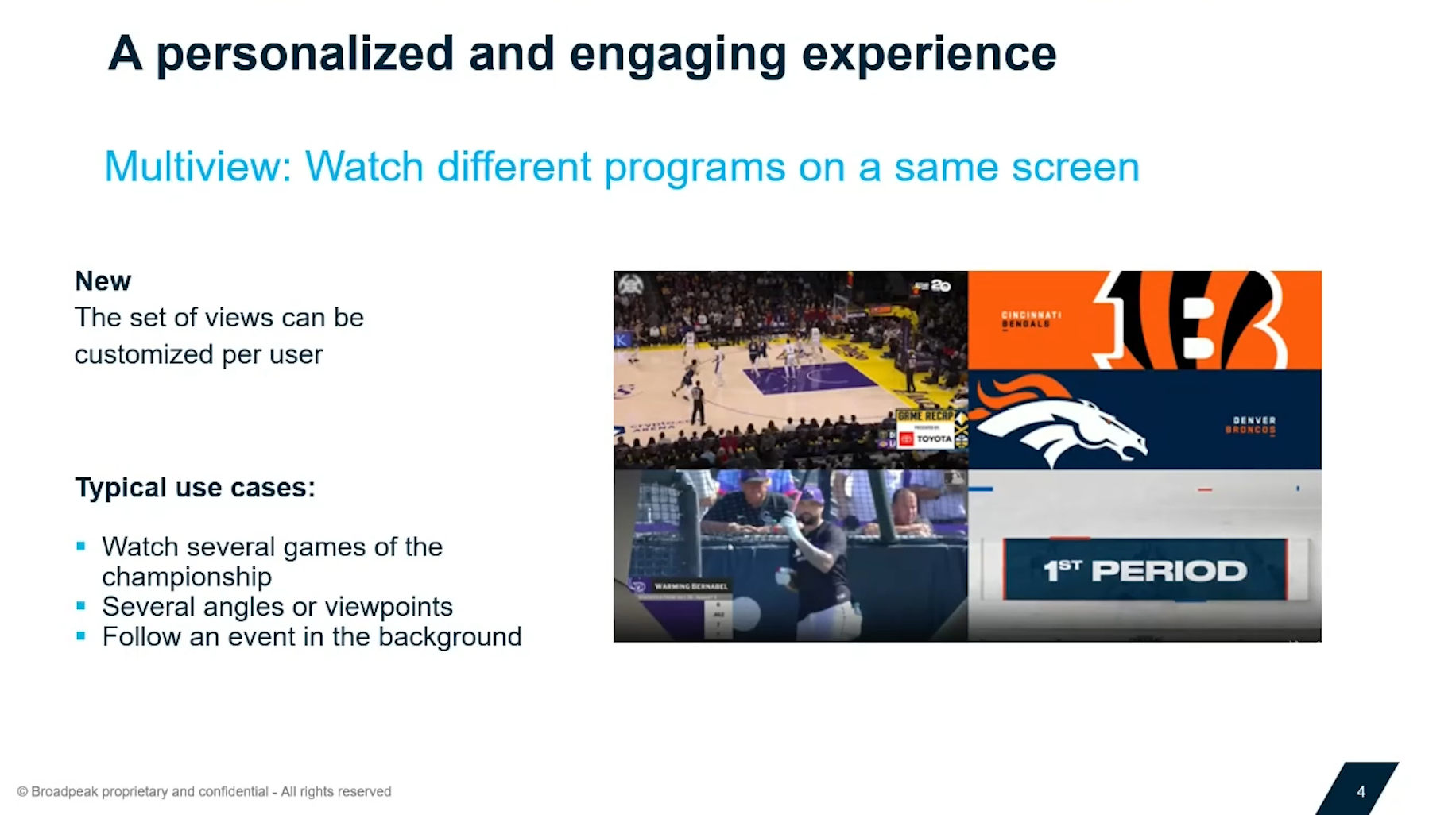
With the company background established, the conversation turned to multiview itself. The concept is straightforward: multiple programs displayed simultaneously on a single screen, as shown in Figure 2. But Sterkers was quick to distinguish it from an older, superficially similar idea. “Sometimes the first remark that I’m getting is, ‘Oh, I know this, back in the time, maybe 20 years ago, it was called a mosaic.'”
The difference, he explained, is control. “The mosaic was very static. The operator was deciding on maybe four or five pages of mosaic. With multiview, the end user gets to choose what content they want to put on the screen and also the overlay, how they want that to be presented.”
The most obvious use case is sports. “If you have a championship where different games are going on at the same time, that’s really one main example of how people would use it,” Sterkers said. Beyond that, viewers might want multiple camera angles on the same game, or simply keep an eye on the news or another game while watching something else. “Maybe the game is getting a bit boring,” he offered, “you want to watch something else at the same time, but still see whenever there’s a goal or anything going on.”
The market dynamics behind Multiview are compelling. The second-screen experience, driven by sports betting, fantasy leagues, and simple generational habit, has become enormous. Publishers who can’t capture that attention on the main screen risk losing it to a phone, along with the revenue that goes with it. Multiview brings that activity back into the primary viewing experience, where publishers can monetize it.
Market education & validation
Would your product benefit from an independent technical analysis like this?
Our market education and validation service creates and distributes independent benchmarks, clear product explainers, and polished technical interviews. Proof that turns prospects into customers.
Learn how it works →Traditional Client-Side and Server-Side Multiview
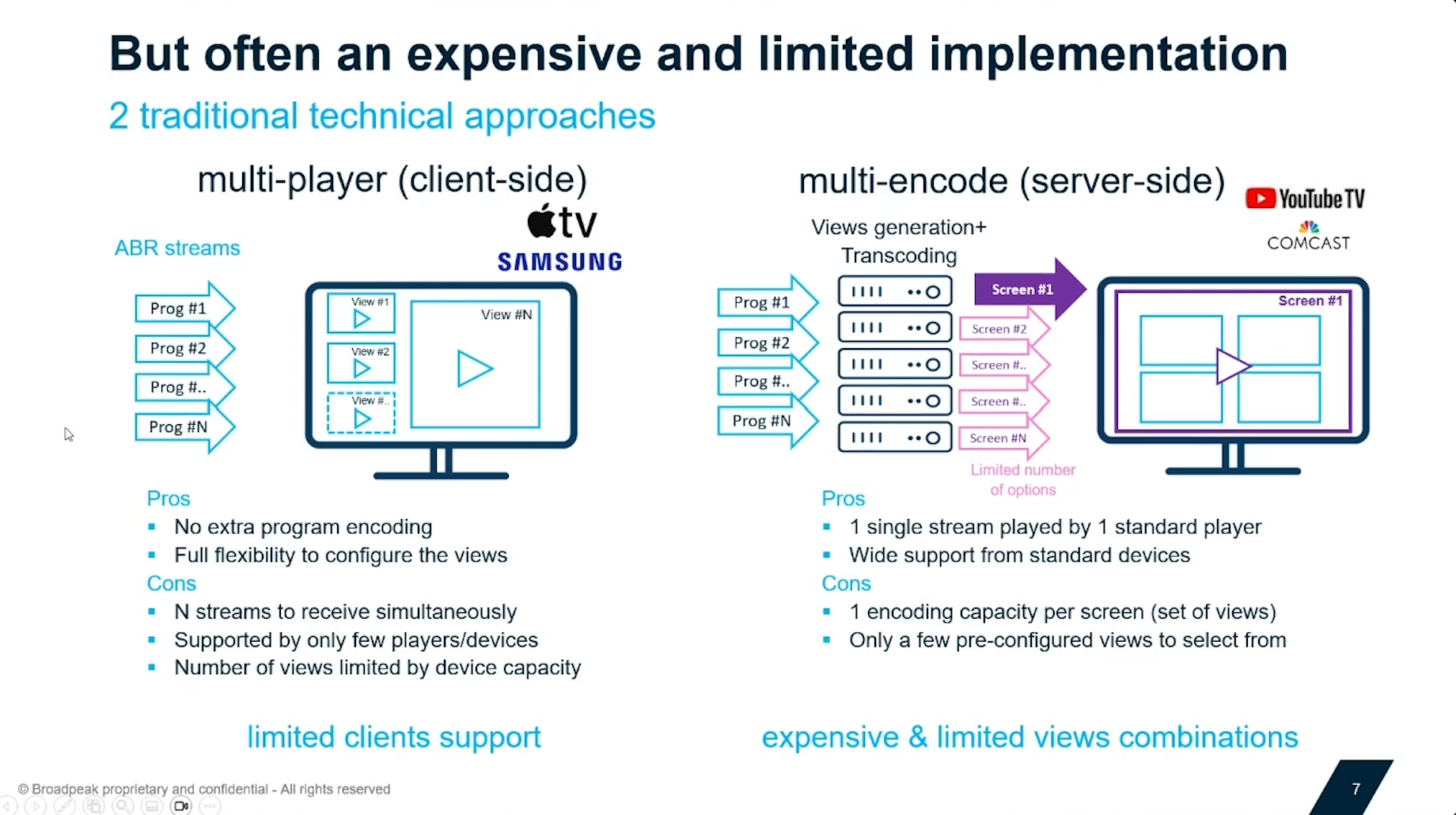
As shown in Figure 3, there are two established ways to implement multiview, each with significant drawbacks.
The server-side approach, called multi-encode, is what YouTube and Comcast have deployed. “The principle is to prepare combinations in advance in the system,” Sterkers explained. “When a user requests a combination, it will be a specific combination that is prepared as a different channel or a different video.” The key advantage is universal device compatibility: it looks like any standard stream to any player.
The problem is cost. Every unique combination requires its own encoder. With 20 input channels and five layouts, you can quickly reach tens of thousands of combinations, each needing dedicated encoding capacity. Most publishers sensibly limit their options, but as Staerkers noted, the relationship between inputs and outputs is factorial, not linear. “You can add a little bit at the input, and it makes a big difference at the output.”
The client-side approach, called multi-player, flips the problem. No extra encoding is needed since the existing streams are reused, and users get full flexibility to build their own layouts.
But all the heavy lifting moves to the device. “There are only very few players that are able to deal with that,” Sterkers said. FuboTV launched client-side multiview on Apple TV in 2021 and didn’t expand to other platforms for four years, a telling sign of how limiting device constraints can be. The multitude of lower-powered smart TVs in living rooms simply can’t handle receiving and compositing multiple simultaneous streams.
In short, client-side is cheap on the transcoding side but reaches few devices; server-side reaches all devices but gets expensive fast.
Broadpeak’s Multi-Package Multiview
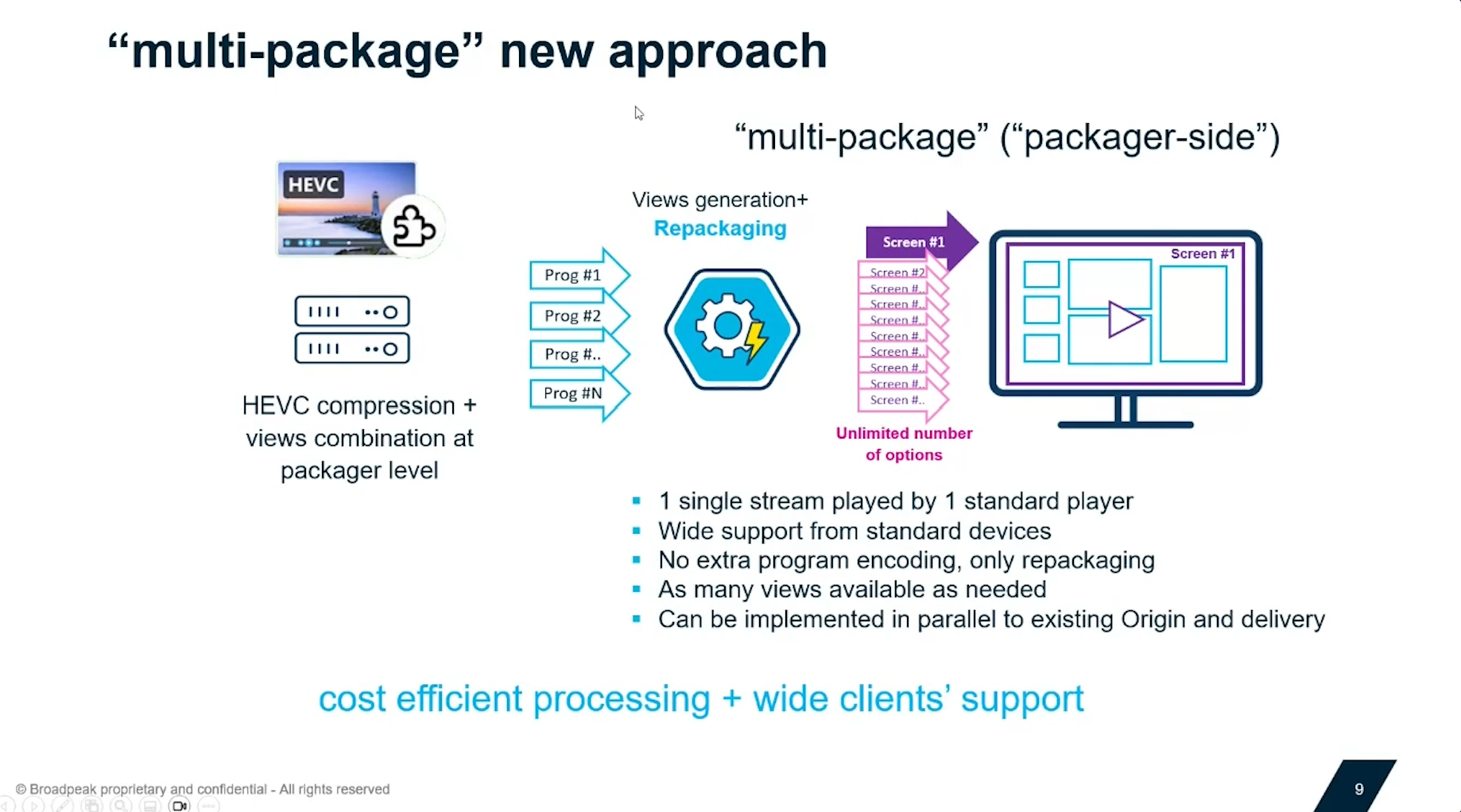
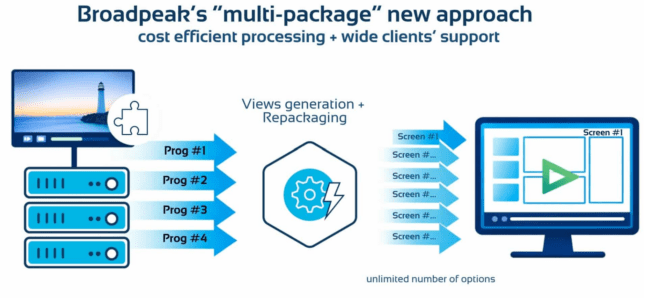
Broadpeak’s solution takes a third path. “Instead of doing it at the encoding level, which is quite expensive in terms of processing, we’re doing it at the packaging level,” Sterkers explained. Each input channel is encoded just once. From there, the system assembles combinations on the fly at the packaging level, no additional encoding required.
As I summarized during our conversation: “So, you’re manipulating metadata; you’re not re-transcoding.” Sterkers confirmed this, adding that while repackaging does require some processing, it’s “in the range of 100 to 1,000 times less CPU usage than if you were using an encoder.”
HEVC Inputs and Outputs Required
Significantly, this approach only works with HEVC source streams, as specific tools in the HEVC specification enable the tile-based encoding and repackaging that makes multi-package work. “For that client, it’s just a normal HEVC channel,” Sterkers said, and he estimated that roughly 90% of devices currently support HEVC, with nearly 100% of new devices shipping with HEVC capability.
In practice, the limitation is minimal. Multiview is primarily a big-screen experience, and any large TV purchased since 2015 almost certainly supports HEVC, making 90% a conservative estimate. The fringe cases are browsers and older devices, where multiview is unlikely to be a priority anyway.
The scale advantage over multi-encode is significant. “Where we had the capacity that was limited, let’s say, to 100 combinations with multi-encode, now it would be more in the range of 10,000 or 100,000,” Sterkers said. “If you put enough servers, you can consider that you will never reach that limit.”
H.264 Inputs and Legacy Devices
At this point, I asked about legacy support for H.264, both for input streams entering the system and for output streams to legacy devices.
On the input side, the answer is straightforward. Broadpeak can transcode H.264 sources to HEVC, and since each input is only encoded once, the cost is minimal, so ten input channels means ten encoders, full stop.
Output is a different story. Delivering H.264 to legacy devices means re-encoding every combination, which puts you right back into multi-encode/server-side territory. It’s technically possible, but as Sterkers put it, “most operators prefer to abandon the very old devices and pay for a system that is much less expensive and much more lightweight.”
Advantages of Multi-Package
The multi-package approach combines the best of both traditional methods. Like server-side/multi-encode, it delivers a single stream that any standard player can handle, with wide device support. Like client-side/multi-player, it doesn’t require encoding every combination. “You encode just the inputs,” Sterkers noted, and in many cases, that encoding is already part of the existing delivery system.
The result is dramatically more flexibility at a fraction of the cost. “You can propose to your customers hundreds of times more combinations than you would with server-side/multi-encode,” Sterkers said. The solution also layers on top of existing infrastructure, so operators don’t need to rip and replace their current origin packager to add multiview.
Dynamic Ad Insertion on Multi-Package Multiview
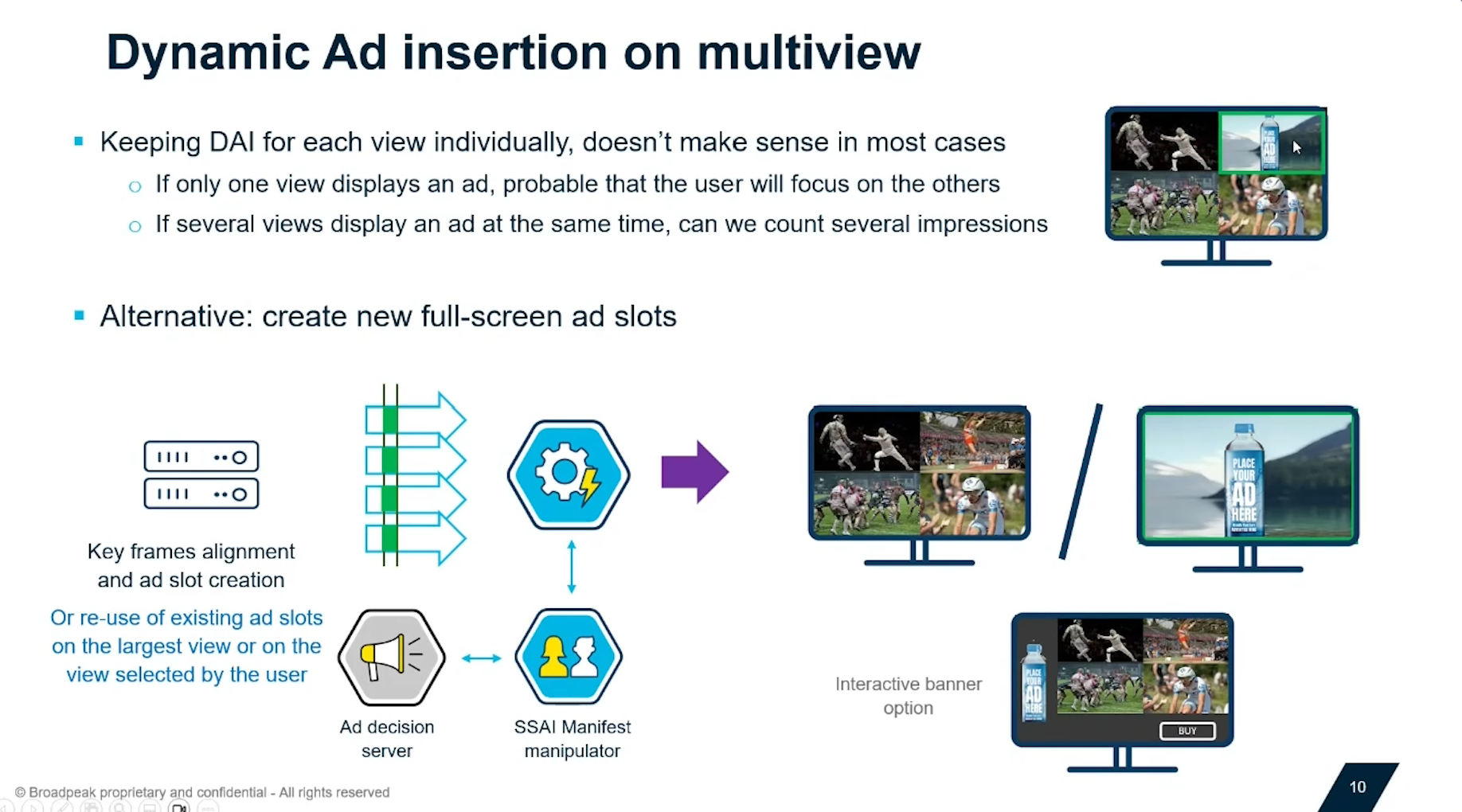
Ad insertion in a multiview environment raises an obvious question: if one tile breaks to an ad while the others keep playing, does anyone actually watch it? Sterkers acknowledged the concern and said that Broadpeak’s preferred approach is full-screen ads.
Since each multiview combination is treated as its own channel, it can be handed off to the dynamic ad insertion system like any other. “We just announce to the ad server that we have more inventory available, and it can decide to insert ads specifically on this multiview application.”
This level of ad integration is still a work in progress; Sterkers noted it isn’t part of any current deployment phase. But he sees no fundamental blocking point, and suggested multiview could actually open up new ad formats. A standard L-shaped banner, for example, typically zooms out the video and fills the surrounding space with a still image. With multiview, that space could carry a live video instead.
Sterkers also noted that interactive elements, like banners, buttons, and zoom overlays, work just as they would on a standard stream.
Multiview API and Demo
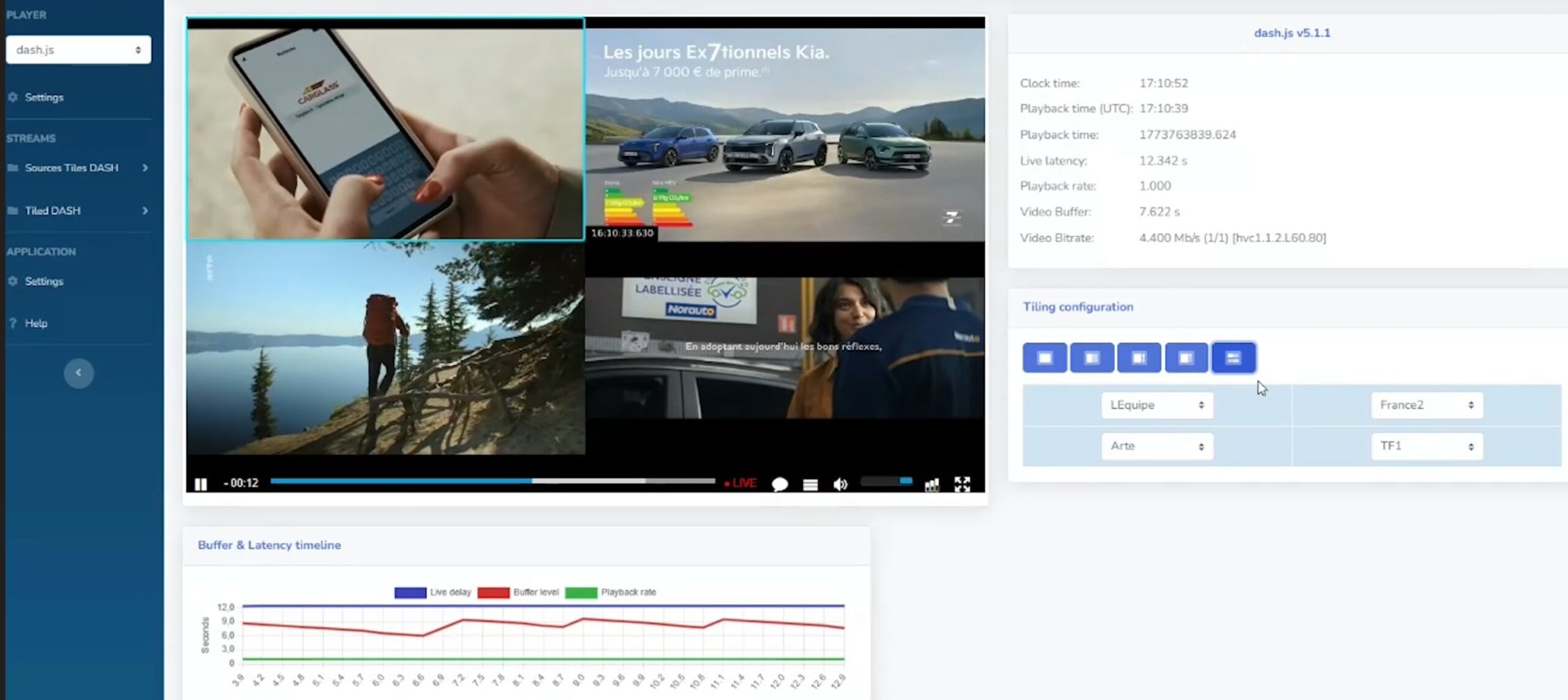
Sterkers then switched to a web demo. He explained that the multiview combination is driven entirely through URL query parameters, one parameter per tile specifying the content, plus a layout parameter to define how they’re arranged. The system builds the combination on the fly and returns a single stream. Switching channels or changing layouts is as simple as updating the URL.
One bonus of working at the packaging level rather than the encoding level: no added latency. “Here at the packaging level, switching multiviews avoids any transcoding latency,” Sterkers said.
The player itself needs no special capabilities; any standard player capable of decoding HEVC will handle it. The intelligence lives in the app, which needs to handle tasks such as tile selection and layout switching. During the demo, Sterkers showed how this logic extends to the audio track, noting that the sound automatically follows the primary tile. “The sound will be on the big one,” he explained, “and if I click on another tile, the audio will follow.”
Broadpeak has built a demo app that shows how straightforward that logic can be and is compatible with Shaka Player, THEOplayer, Safari, and others. It’s available on request.
Availability and Deployment Options
Broadpeak announced the product last month, with undisclosed projects already underway. Sterkers shared that interest is strongest in the US, though discussions with European operators and in Latin America are also in progress.
In terms of how quickly the technology can be deployed, Sterkers stated that deployment is faster than either traditional approach because so much less hardware is involved. A large configuration supporting 10,000-20,000 combinations can run on a single server plus a redundant backup. On-prem, cloud, or fully managed service are all options, and operators can start with managed service to get up quickly, then transition on-prem later if preferred.
Summary
Broadpeak’s newly launched multi-package multiview solution is already generating worldwide interest. With NAB just around the corner, it’s a safe bet the technology will be a centerpiece of their presence at the show. Operators interested in learning more can reach out to Broadpeak directly or stop by their booth in Las Vegas. Click here for more on meeting with Broadpeak at NAB.