 Streaming Learning Center Where Streaming Professionals Learn to Excel

Related Articles


Live streaming has a fundamental tension that no existing protocol fully resolves. On one side sits WebRTC, which Ant Media describes as “ideal for real-time, interactive, low-latency communication like video calls, conferences, and interactive live streams.” On the other side sit HLS and DASH, which remain HTTP-based, CDN-friendly, and operationally mature at large scale, but practical low-latency variants still usually land in the low-single-digit seconds rather than sub-second territory, as several NAB 2026 engineering reviews point out.
For example, a pre-NAB 2026 review of low-latency streaming architectures pegs LL-HLS and LL-DASH in the 2–6-second range and contrasts them with sub-second MoQ demos. Any platform that wants low latency at scale typically ends up stitching these worlds together with custom infrastructure, protocol translations, and operational complexity.
Media over QUIC, or MoQ, is the IETF’s attempt to build a single protocol to bridge the gap. The MoQ working group says it was formed to “develop a simple low-latency media delivery solution for ingest and distribution of media,” and the IETF blog describes MoQ as “a media delivery solution that has the potential to transform how we send and receive media during live streaming, real-time collaboration, gaming, and more.”
By NAB 2026, that ambition had become visible across the show floor. Bitmovin and Cloudflare demoed live MoQ playback, Oracle and partners showed MoQT-based workflows, Broadpeak featured MoQ in joint live streaming demos, Ant Media highlighted MoQ comparisons in its booth, Faultline’s coverage documented nanocosmos’ MoQ CDN story, and the Streaming Summit hosted an “OpenMOQ and MoQ” session focused on next-generation streaming.
Contents
QUIC: The Foundation Under MoQ
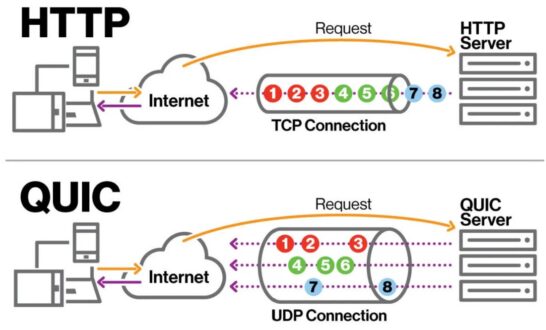
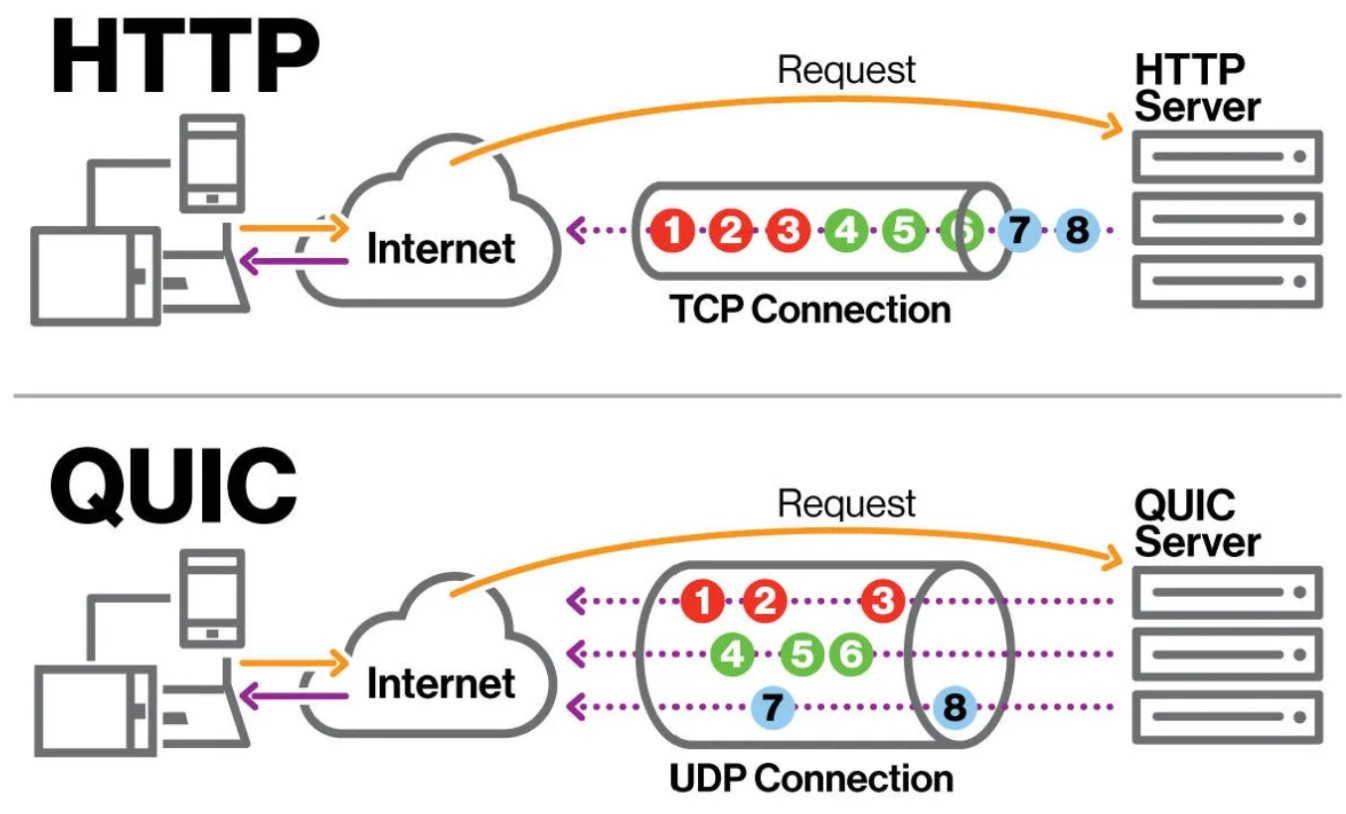
MoQ depends on QUIC because QUIC fixes transport problems that are painful for media. TCP suffers from head-of-line blocking when multiple streams share a single connection, meaning the loss of a single packet can stall unrelated streams until the retransmission completes. APNIC explains that QUIC “relieves HOL blocking as it is stream-aware such that it knows which specific streams have been affected,” so only the affected stream waits while the others continue.
Writing in Medium, Aditi Mishra further explains, QUIC “addresses HOL blocking at the transport layer by using UDP instead of TCP. QUIC allows multiple independent streams within a single connection, so packet loss in one stream doesn’t block others.” The image in Figure 1 explains the difference.
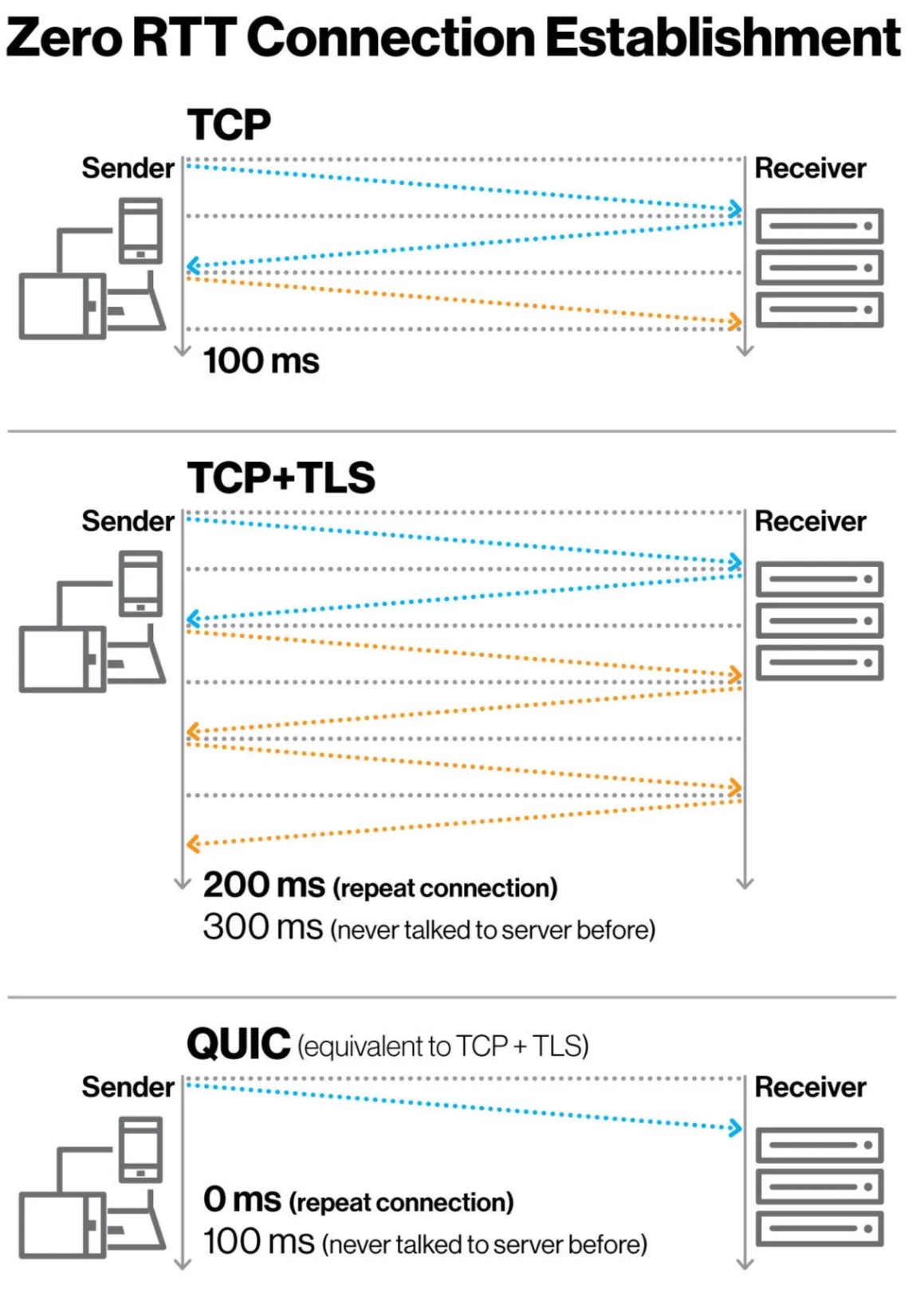
In addition to avoiding head‑of‑line blocking, QUIC also reduces connection setup time compared with TCP plus TLS. Because QUIC combines transport and encryption in a single handshake, it can start sending application data in fewer round-trips, which cuts tens to hundreds of milliseconds off the time‑to‑first‑frame, as illustrated by the timing diagrams for standard TCP+TLS versus QUIC.
What MoQ Actually Is
With that as background, MoQ is a publish/subscribe media transport protocol built on top of QUIC. APNIC describes it as “a generic live pub/sub framework designed for CDNs and mass fanout.” Cloudflare explains that MoQ’s core innovation is “treating media as subscribable tracks in a publish/subscribe system,” with three main roles:
- “Publishers: Announce track namespaces and send Objects.
- Subscribers: Request specific tracks by name.
- Relays: Connect publishers to subscribers by forwarding immutable Objects between them.”
Broadpeak adds that “MoQ is built around a publish/subscribe model. A client subscribes to one or more media tracks, and the publisher makes the corresponding media objects available. Relay nodes in the network handle fan-out and caching.”
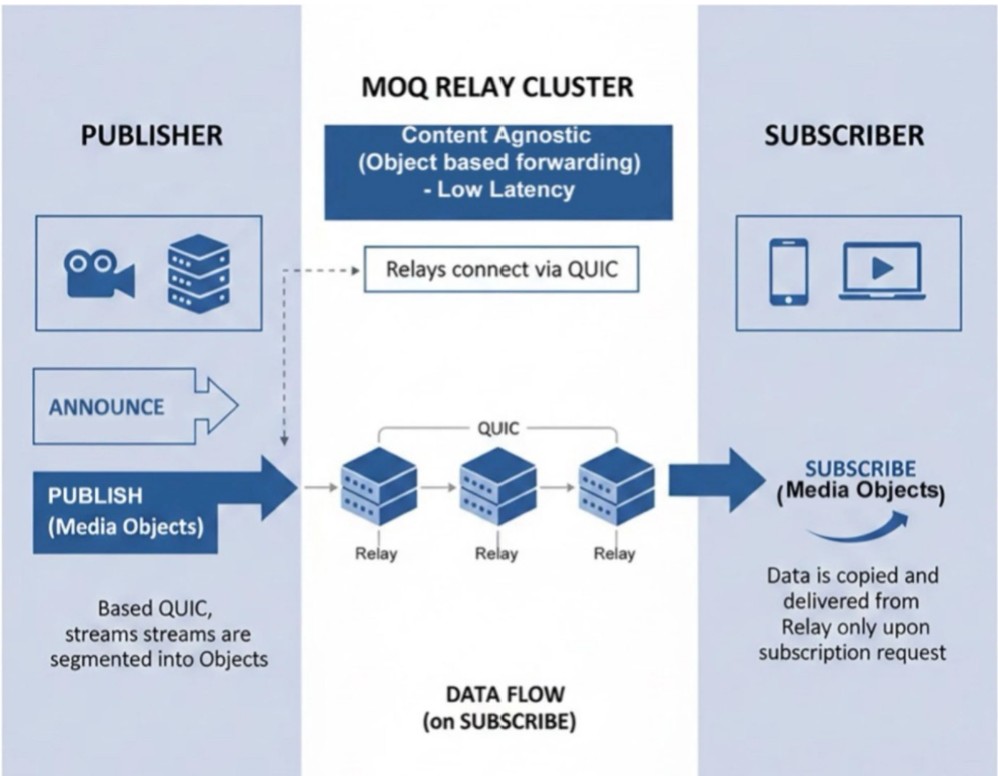
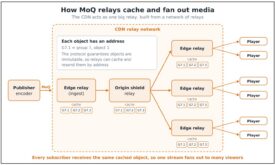
Figure 3 illustrates the standard MoQ delivery model: a publisher sends media objects (video, audio, data) into a MoQ relay fabric, where each relay forwards and caches those objects before passing them downstream to other relays or subscribers. Rather than every viewer maintaining a separate connection to the origin, subscribers attach to nearby relays that handle both fan‑out and short‑term storage, applying the publish/subscribe model the MoQ architecture is built on.
The IETF charter states that “media will be mapped onto underlying QUIC mechanisms (QUIC streams and/or QUIC datagrams) and can be used over raw QUIC or WebTransport,” and that the working group will define the protocol so it can “leverage coordinating relays, caches, or replication points wherever applicable to improve the delivery performance.” The IETF blog also notes that MoQ’s publisher–subscriber protocol “supports multiple media formats, interoperability when indicating the media and media format being sent, rate adaption strategies… and cache-friendly mechanisms.”
The wire protocol being standardized is formally called MoQT, for Media over QUIC Transport. In its NAB post, Oracle’s Video @ Edge team explains that “any system that speaks MoQT (Media over QUIC Transport), the IETF wire protocol, can publish or subscribe to any Track without prior bilateral negotiation,” which is exactly the interoperability story vendors are trying to build around the spec.
Publishers, Subscribers, and Relays
The architectural feature that most clearly separates MoQ from both WebRTC and classic HTTP streaming is the relay. In a MoQ deployment, publishers don’t send a separate stream to every viewer. Instead, publishers send media Objects over the network; relays receive and cache those Objects; and subscribers retrieve them from a nearby relay or a chain of relays.
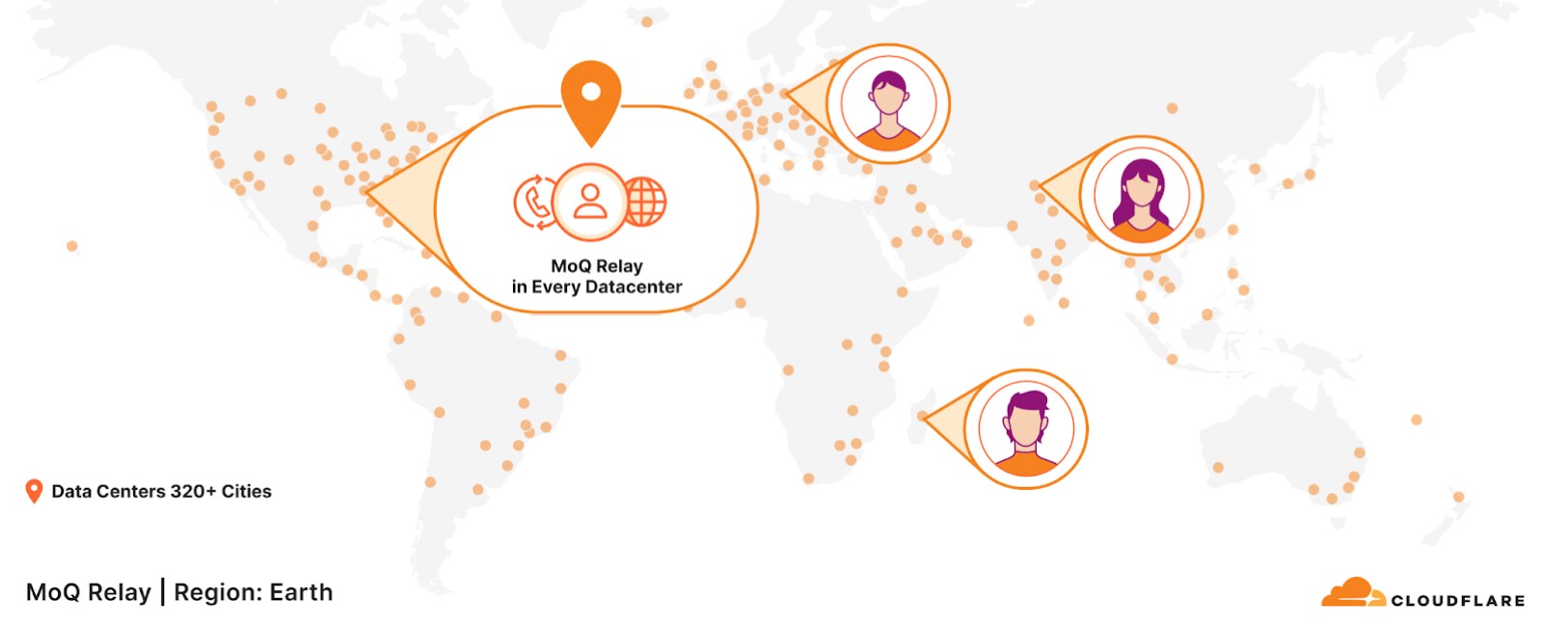
MoQ relays are typically operated by the same kinds of organizations that run today’s delivery infrastructure, including CDNs, cloud and platform providers, and network or service operators, depending on the deployment. Cloudflare’s explainer and Broadpeak’s article both emphasize that relays handle the fan-out and caching, not the origin server.
The IETF blog explains that these relays “function as cache mechanisms, where copies of media are stored and then are distributed as needed.” APNIC gives a branch-office example: “With MoQ, a media relay installed at that local branch office would enable fan out, meaning the content from that call only travels one time. Copies are stored in the local relay and then are distributed within the branch office as many times as necessary.” That is essentially CDN logic applied to real-time media: one upstream copy, local distribution, and less waste across the backbone.
APNIC also argues that “the allure of MoQ is that a single delivery network, protocol, and format can address multiple market segments concurrently,” which “affords lower network OPEX and better capacity management while maximizing the addressable market.” That is a large part of why MoQ attracts attention from CDN, player, and infrastructure vendors rather than just RTC specialists.
How MoQ Compares to WebRTC and HLS/DASH
WebRTC vs. MoQ
WebRTC and MoQ overlap, but they don’t target the same core use case. Ant Media’s article on WebRTC vs MoQ says, “For use cases where responsiveness is existential — live auctions, telehealth consultations, remote drone monitoring, interactive sports betting — there is simply no better option available at production scale today. MoQ will shine in large-scale events like “Concerts, sports broadcasts, and political events where you need sub-second latency for a million simultaneous viewers.”
nanocosmos writes that it “leverages both WebRTC and MoQ depending on the use case,” using WebRTC for browser-based ingest in web applications and MoQ as “the go-to choice for stable, large-scale delivery to a global audience.” In practice, that means WebRTC remains the best fit for true interactive sessions, while MoQ is being shaped as a better fit for one-to-many distribution where sub-second latency matters but full conversational interactivity is not the primary requirement.
HLS/DASH vs. MoQ
The comparison with HLS and DASH is different. Those protocols are deeply integrated into today’s CDN and player ecosystems, which is why they dominate at scale. But low-latency variants still usually operate in the 2–6 second range in real deployments, not the sub-second range that vendors now target with MoQ.
Bitmovin and Cloudflare say that MoQ can enable “sub-second latency for millions of concurrent viewers over standard web infrastructure.” That “millions” language is a forward-looking architectural claim rather than a published benchmark, but it captures the design intention clearly.
MoQ therefore sits between two worlds: it’s not trying to replace WebRTC for conversational applications, and it is not merely another flavor of HTTP chunked streaming. It is trying to create a third option: relay-based, sub-second, internet-scale media delivery over QUIC.
Who Is Building on MoQ Today
MoQ is no longer just a paper specification. The IETF blog reported that at IETF 118 “some degree of interoperability was achieved for the first time among the six early implementations,” which is a meaningful milestone for any emerging protocol. The MoQ transport draft remains active and continues to evolve through working-group discussion and interims, as reflected in the 2026 interim minutes.
nanocosmos claims to be the “first vendor to bring Media over QUIC into production in 2025, with its official launch on the nanoStream platform during the IBC 2025.” Faultline reported after NAB 2026 that nanocosmos customers were already using its MoQ CDN in live environments “at small-scale in the low hundreds of thousands of concurrent users.”
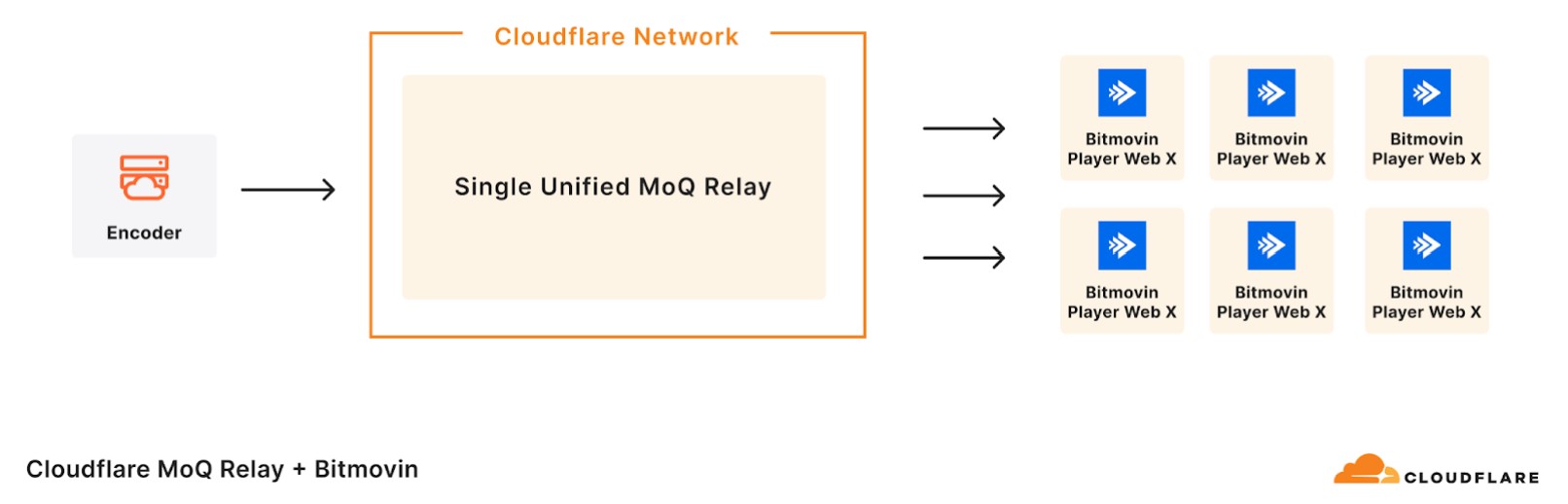
At NAB 2026, Bitmovin and Cloudflare demonstrated live MoQ playback, with a Bitmovin encoder publishing into Cloudflare’s network, which then acted as a MoQ relay fabric to deliver the stream to Bitmovin players around the globe.
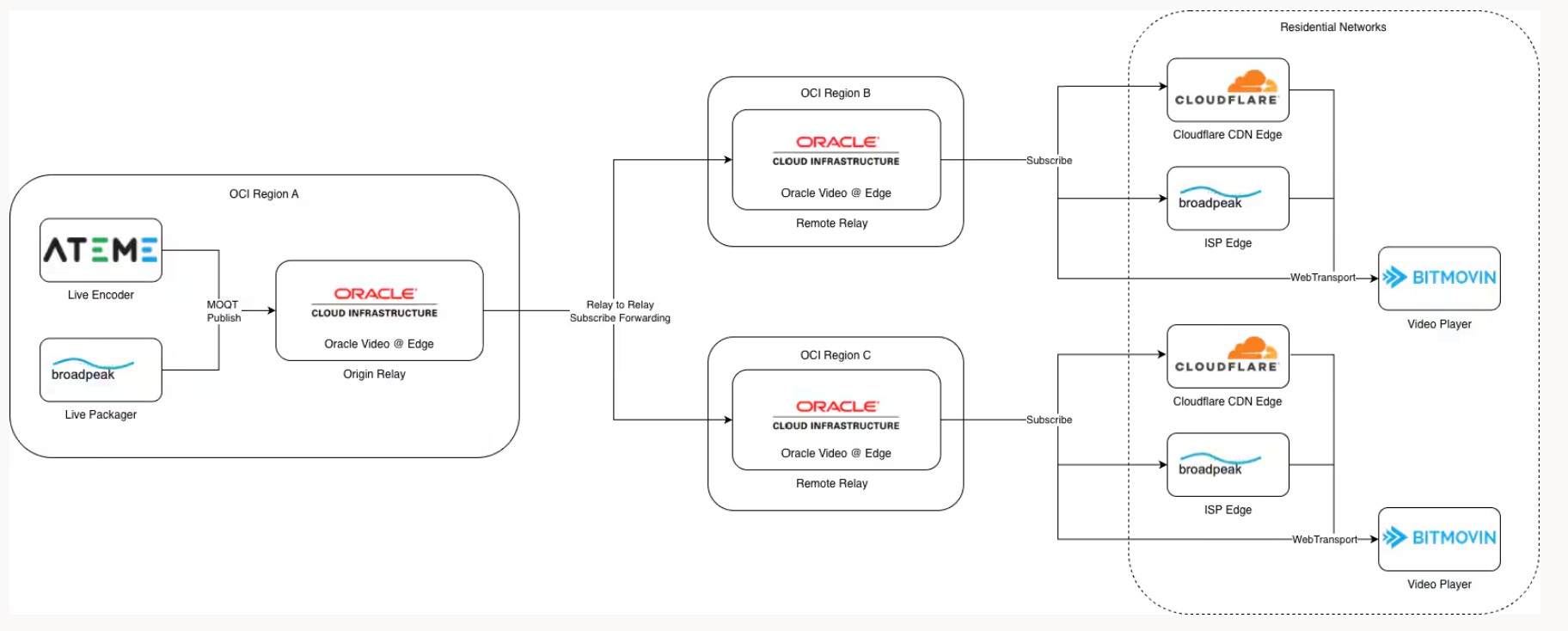
Oracle’s Video @ Edge team described its NAB 2026 demos as “a collection of demonstrations developed with partners that show how independent systems interoperate through a shared transport model,” all speaking MoQT.
Broadpeak’s NAB material positioned MoQ as part of a live streaming and monetization workflow, describing it as “the new protocol that offers enhanced live streaming performance with faster zap times, lower latency, and reduced re-buffering.”
What Isn’t There Yet
MoQ is still a draft, not a finished RFC. The IETF working group notes that it “will develop a simple low-latency media delivery solution,” which clearly signals that the work is still underway rather than complete. Interim meetings in 2026 discussed features such as REWIND to improve join behavior, and those ideas had not yet been incorporated into a final, stable standard by late April 2026, as seen in the interim minutes and the evolving MoQ transport draft.
A useful way to think about MoQ in 2026 is as feature-complete enough to support demos and some targeted production deployments, but not yet boring, default infrastructure. The table below sketches what is effectively “there,” and what still needs time.
| Area | What’s effectively there | What’s not mature yet |
|---|---|---|
| Standardization | MoQT and related documents have stabilized sufficiently that multiple vendors can interoperate on late-stage drafts, and the overall architecture is well-defined in the IETF overview. | There is still no final RFC, and details such as relay behavior and advanced features like REWIND are being refined in working-group discussions and interim meetings, so wire behavior can still change. |
| Browser and player support | WebTransport and HTTP/3 are now available in mainstream browsers, and vendors such as Bitmovin, nanocosmos, and Ant Media have shipped players or servers that can speak MoQ, as described in Bitmovin’s MoQ player article and nanocosmos’ explainer. | There is no native MoQ stack in browsers; everything depends on JavaScript libraries and custom players, and interoperability across different vendor implementations is still in its early stages rather than routine. |
| Implementations and deployments | Several companies have working MoQ-based systems, including nanocosmos’ MoQ CDN, Bitmovin with Cloudflare’s relays, and Ant Media Server, which demonstrated live workflows at NAB 2026, as described in Faultline’s coverage and in Bitmovin’s and Cloudflare’s NAB post. | These stacks target draft versions of the spec and are not yet aligned on a frozen profile, so coordinated upgrades will be needed as the standard evolves. Feature coverage is uneven across vendors. |
| Ecosystem features | Core media delivery works: sub-second live playback, pub/sub fan-out through relays, and basic content-agnostic object forwarding, as outlined in Qualabs’ overview. | Broad, multi-vendor solutions for ad insertion, DRM, complex rights workflows, and standardized telemetry are still being prototyped; they do not yet match the maturity of comparable HLS/DASH/WebRTC ecosystems. |
| Performance evidence | Vendor demos and early lab work show MoQ achieving sub-second glass-to-glass latency, and academic studies are starting to benchmark MoQ-based adaptive streaming, including the thesis “Evaluating Media over QUIC (MoQ) for Low-Latency Adaptive Streaming”. | The industry still lacks broad, published performance data at global scale across diverse networks, especially compared with the many years of real-world data behind HLS, DASH, and WebRTC, as noted in the pre-NAB review “Evaluating Low-Latency Streaming Architectures and Protocol Evolution at NAB 2026.” |
The upside is that MoQ’s design space extends beyond video streaming. The IETF blog notes that similar pub/sub delivery patterns could be valuable for IoT telemetry and event notification. That broader potential explains why some vendors are already running MoQ in production for specific workflows, while many others still treat it as near-term, but not yet fully settled.
The Takeaway
MoQ is a QUIC-based publish/subscribe transport with built-in relays and caching. Its backers position it as the protocol that can finally combine sub-second latency with broad fan-out and CDN-like scalability. In practical terms, that means MoQ will sit between WebRTC’s interactive strengths and HLS/DASH’s scale strengths, without inheriting the worst compromises of either.
The promise is not fully proven yet. The spec is still moving, the ecosystem is still normalizing around draft behavior, and even supportive vendors acknowledge that MoQ is not yet ready for every production use case. But after NAB 2026, MoQ is best understood not as a lab curiosity but as an emerging industry standard with real momentum, real implementations, and enough public evidence to justify serious attention from anyone building low-latency streaming systems.