 Streaming Learning Center Where Streaming Professionals Learn to Excel

Related Articles


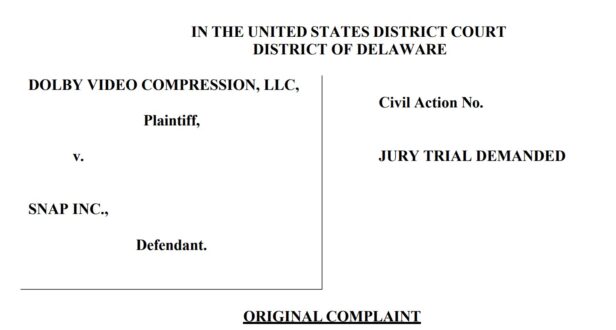
On March 24, 2026, Dolby sued Snap Inc. (Snapchat) for AV1 and HEVC patent infringement in the United States and Brazil. The suits are the first AV1 assertion against a streaming platform by an Access Advance licensor, and Dolby is seeking injunctive relief in both countries. The reason this matters beyond Snap is a single legal fact: Dolby is asserting that it has made no FRAND or royalty‑free commitments for AV1, so the royalties the court sets for the asserted AV1 patents are not constrained by any Fair, Reasonable, and Non-Discriminatory obligations.
To explain, when a company’s patents are essential to a standard it helped develop, it typically makes a FRAND commitment to the standard-setting organization, a binding promise to license on Fair, Reasonable, and Non-Discriminatory terms. Courts can enforce that commitment to cap what a patent holder can demand.
That pressure valve doesn’t exist here. As an article in IP Fray explains, “As Dolby did not participate in the development of the AV1 standard, it did not make any promises with respect to licensing AV1 implementations. Dolby is not even bound by any FRAND pledge because any of its FRAND pledges for video patents relate to standards in the development of which it was involved. As a result, there is no contractual FRAND (much less royalty-free) defense to Dolby’s pursuit of injunctive relief.”
Focusing on the US suit, what are the practical implications of the lack of FRAND status? There are two.
Contents
1. A Heightened Threat of Injunctive Relief
In standard-essential patent (SEP) litigation, a FRAND commitment typically acts as a checkbook defense for implementers. When a patent holder promises to license technology on fair and reasonable terms, U.S. courts generally view monetary damages as an adequate remedy, making a permanent injunction, which requires proving irreparable harm that money cannot fix, extremely difficult to obtain.
The Federal Circuit has noted that a FRAND commitment “strongly suggests that money damages are adequate,” making an injunction “unlikely” because the patent holder has already expressed a willingness to trade their right to exclude for a royalty.
Without a FRAND commitment, that contractual pressure valve is removed. For this reason, it’s not surprising that Dolby’s complaint asked for the injunction like this:
“While Dolby contributed its inventions to the HEVC standard and licenses those HEVC-essential patent claims through established patent pools on RAND terms, Dolby did not contribute its inventions to be incorporated into the AV1 specification or agree to any of AOM’s policies. Accordingly, Dolby has made no contractual RAND commitment with respect to AV1. Dolby seeks injunctive relief against Snap’s infringing decoding of AV1-compliant videos and encoding videos into AV1-compliant formats.”
2. The Removal of the Damage Ceiling
The second implication of a lack of FRAND status is the calculation of damages. In a FRAND environment, the Fair and Reasonable promise creates a natural cap on what a patentee can demand. Removing that status shifts the analysis from a contract-based fair rate to a standard patent infringement framework, where the goal is to fully compensate the owner for the unauthorized use of their property.
Codec economics consulting
You're about to make a seven-figure codec licensing decision. Are you sure you've accurately estimated the EBITDA impact?
Our codec economics service models the EBITDA impact using your ladders, your encoder, your delivery costs, and your royalty exposure. The most accurate estimate you can get.
Learn how it works →But that doesn’t mean that the court will rubber-stamp any amount that Dolby claims. As Patent Progress explains, without a FRAND commitment, courts fall back on standard reasonable royalty tools, primarily a framework called Georgia-Pacific that asks what a willing licensor and willing licensee would have agreed to at the time infringement began. It’s not a blank check, but it’s a much wider range than FRAND allows.
The clearest illustration of how this plays out in court comes from Optis v. Huawei, where a non-FRAND H.264 video patent coexisted with four FRAND-committed patents in the same trial. The jury awarded $7.7 million on the single patent without a FRAND commitment, nearly three times the combined $2.8 million awarded for the four FRAND-encumbered patents. As Akin Gump’s subsequent case summary confirms, the court entered final judgment of $10,553,565 and then enhanced that by 25 percent for willful infringement, with Huawei also on the hook for PanOptis’s attorneys’ fees after the court found a “widespread pattern of litigation abuse.”
The jury instructions made the structural difference explicit: for the FRAND patents, a reasonable royalty cannot exceed “the amount permitted under PanOptis’ FRAND obligations.” For the non-FRAND patent, no such ceiling applied, and that difference appeared to show up clearly in the jury’s award. I say “appeared to” because the differential in the award could also have arisen from the perceived value of the respective patents, though the jury instructions still tell the tale.
Limiting Damages to the Actual Value Contributed
Even without FRAND, courts won’t let Dolby charge for the market power that comes from AV1’s adoption. It can only charge for the actual commercial value its technology contributes to Snap.
This is clear from the jury instructions in the PanOptis’ trial: “the FRAND royalty rate must be based on the incremental value that the patented technology adds to the product, not any value added by the standardization of that technology.” In other words, Dolby has to justify its royalty demand based on what its technology actually contributes, not on the leverage that comes from AV1’s widespread deployment.
Comparable licenses also work as a practical anchor. The existing Access Advance Video Distribution Patent pool, the Avanci Video program, and rates from prior HEVC disputes all become reference points a court will use to test whether Dolby’s ask is reasonable. And as the W&L Law Review analysis points out, when acceptable non-infringing substitutes exist, they effectively cap what a willing licensee would rationally pay. Snap can encode and deliver video using AVC, HEVC, or VP9. That optionality isn’t a complete defense, but it’s a real constraint on the upper end of any damages award.
The bottom line for U.S. proceedings: Dolby has meaningfully more leverage than a FRAND-bound patentee, both for seeking an injunction and increased damages. The Optis v. Huawei numbers suggest that the gap can be substantial. But courts will still push Dolby to justify its royalty based on the incremental value of its technology, comparable licenses, and what a rational implementer would have paid knowing it had alternatives.
In addition, note that Dolby is also requesting enhanced damages under 35 U.S.C. § 284. To support this, the complaint asserts that, because Snap was a licensee of the Access Advance HEVC pool, it had knowledge of the patents and infringement. Given such knowledge, Snap’s failure to secure a license for its HEVC and AV1-compliant video processing constitutes a “willful and deliberate” violation that justifies the court increasing the final damages award by up to three times.
What Happens Next?
Where Snap goes from here is pivotal to the industry. Between the threat of a permanent injunction, damages not limited by a FRAND commitment, and the potential for a triple-damage multiplier, Snap faces a level of risk that few in the streaming space have had to navigate. Dolby appears to be positioning this as a test case for its video patent portfolio, and the recent Roku settlement in January 2026 suggests there is a clear, if expensive, off-ramp for those unwilling to risk a Delaware or Brazilian jury.
On the other hand, Snap is an Alliance for Open Media (AOM) Promoter, and if the consortium’s much-ballyhooed, now-disappeared patent defense program was ever going to be deployed, this is the moment. For years, like a proverbial drug dealer, AOM marketed AV1 as a “royalty-free” alternative to the traditional patent pool model, and much of the press and publisher community bought it hook, line, and sinker. At some point, AOMedia either needs to back its members in a high-stakes legal fight or abandon the “royalty-free” pretense. If a top-tier insider like Snap agrees to pay a toll, it confirms that for high-volume platforms, the “free” codec has become a commercial myth.
Author’s Note: IP Fray asserts that the ITU’s FRAND pledge governing HEVC covers decoding only, not encoding, which would further limit Snap’s FRAND protections on the HEVC side of the suit. The complaint doesn’t appear to make this distinction explicitly. It’s worth knowing this argument is out there, but since the FRAND gap on AV1 is both clearly alleged and well-documented, that’s where this article focuses.