 Streaming Learning Center Where Streaming Professionals Learn to Excel

Related Articles


This report illustrates and compares the royalty calculations of two patent licensing programs, Access Advance’s Video Distribution Patent (VDP) Pool and Avanci Video, using eight streaming service templates modeled after well-known platforms.
The purpose is to help streaming services understand how the two programs calculate royalties and compare potential royalty costs side by side. I believe that the best way to accomplish this is to use real-life examples of different types and sizes of streaming companies to illustrate royalty calculations using the metrics specified by the two programs.
The study was sponsored by Access Advance. After agreeing on the companies to include, I (Jan Ozer) independently researched all inputs used in the computations and performed all calculations myself. Assumptions and procedures were selected to reflect typical commercial usage, not to favor either program.
These illustrative calculations are for informational purposes only. They should not be relied on by anyone to determine their royalty costs under each program. Contact each program directly to verify current terms.
Price is a critical input in any licensing decision, but it is not the only one. Other factors merit consideration, including the patents held by each program and the scope of protection a license provides.
Contents
What the Numbers Show
I computed and presented royalties two ways for each program: with current adjustments and discounts applied, and as a full royalty without promotional incentives, to reflect both present and potential future exposure.
With adjustments and discounts applied, Avanci’s royalties range from 1.9× higher than Access Advance (Paramount+) to 30.3× higher (Meta). In the full royalty computation, the range runs from 6.5× (Paramount+) to 31.9× (Meta).
The table below shows the results across all eight service templates.
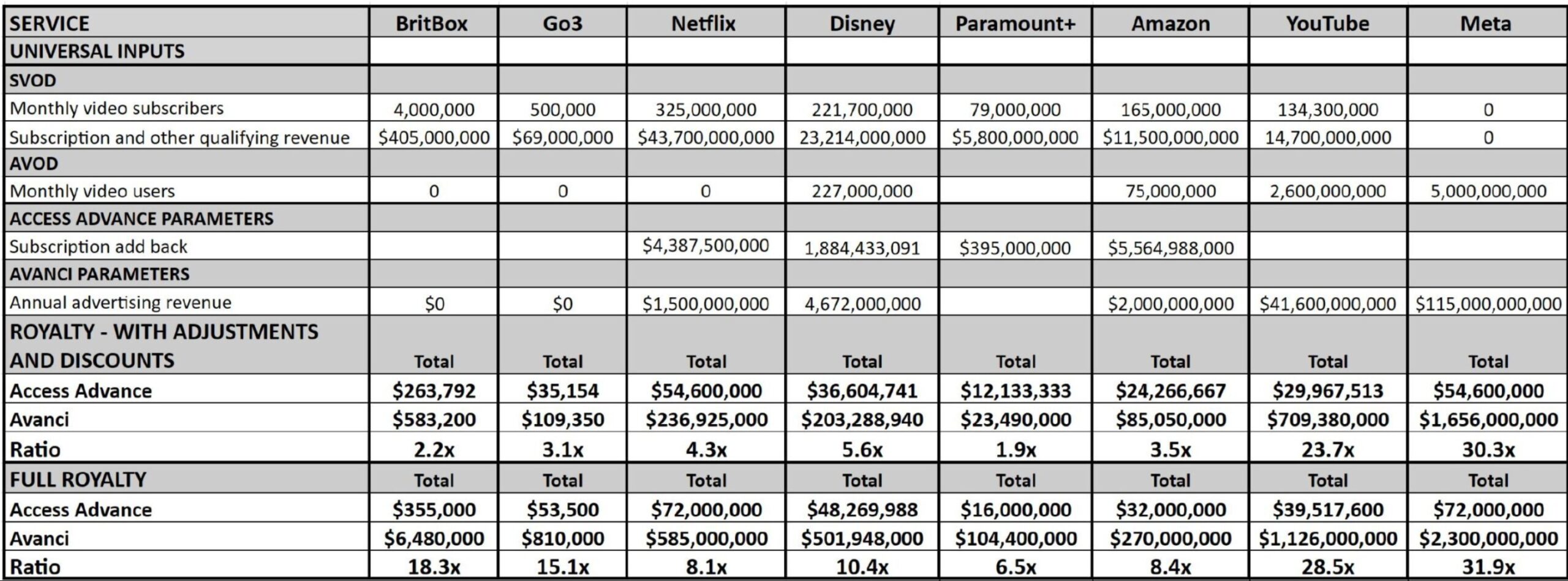
As is detailed in the report, Avanci’s higher royalties are attributable to multiple factors:
Codec economics consulting
You're about to make a seven-figure codec licensing decision. Are you sure you've accurately estimated the EBITDA impact?
Our codec economics service models the EBITDA impact using your ladders, your encoder, your delivery costs, and your royalty exposure. The most accurate estimate you can get.
Learn how it works →- Avanci’s royalty base includes advertising, which Access Advance excludes.
- Avanci’s list rates are higher than Access Advance’s effective rates
- Avanci’s revenue‑based rates are flat; Access Advance’s are tiered. In our modeling, at the highest Access Advance revenue tier, the modeled effective rate is under 0.17%, while Avanci’s lowest published rate is 1.6%, roughly 9.5x higher.
- As of March 2026, Avanci had not announced a fee cap for its video program.
How I Computed the Royalties
Each template uses three categories of inputs: universal inputs (subscribers, users, subscription revenue), Access Advance-specific parameters, and Avanci-specific parameters. The full report contains enough detail for readers to independently verify every royalty figure.
Note that there is substantial overlap in patent ownership between the two programs, which this report did not explore or attempt to quantify.
All information reflects program terms as of March 2026. These illustrative calculations are for informational purposes only. They should not be relied on by anyone to determine their royalty costs under each program. Contact each program directly to verify current terms.
Download the full report:

Questions about the royalty calculations: jan.ozer@streaminglearningcenter.com
(from the report: I won’t take questions about the service inputs and estimates; they are estimates to serve as examples. If you have questions about the royalty calculations themselves, I’ll respond if you share a Google Sheet with a reasonable model of how you computed royalties and how your numbers differ. I don’t open Excel or other files from sources I don’t know.)




Is there any proof Access Advance’s patent claims on AV1 are valid or are they just making it up and hoping no one questions it?
Jim:
Access Advance says here that they will publish a patent list soon. – https://accessadvance.com/licensing-programs/vdp-pool/
As I wrote here, Dolby, a licensor in pool, has sued Snap on the AV1 patents. So, we’ll see.
https://streaminglearningcenter.com/encoding/when-theres-no-frand-what-dolbys-suit-against-snap-means-for-the-industry.html