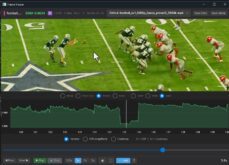
I recently interviewed Damien Sterkers, VP of Products and Solutions Marketing at Broadpeak, to discuss the company’s new multiview solution for live streaming. Briefly, Broadpeak has developed an innovative server-side approach that delivers the best of both worlds: the universal device compatibility of server-side multiview without the massive encoding costs that approach typically requires. You can watch the video on …
Read More »The Next Big Feature in Live Streaming: VMAF-Driven Bitrate Control
For most of the live encoding era, the operator’s main job was picking a bitrate. You’d set a target, the encoder would hit it, and quality was whatever came out the other end. Simple content looked great. Complex content looked terrible. The encoder didn’t care because you told it to deliver bits, not quality. Then came a generation of smarter …
Read More »Contextual Targeting’s Second Act: Past, Present, and Future
Contextual advertising matches ads to content rather than to people. The logic is straightforward: a viewer watching content about home renovation is likely receptive to a Home Depot ad at that moment, whereas a behavioral retarget from last week’s browsing is not. The problem is that behavioral targeting depends on third-party data that is becoming increasingly unavailable as privacy regulation …
Read More »Capped CRF in a Multi-Codec World: FFmpeg and NVIDIA Implementations
I recently consulted with a company that was running capped CRF-type encoding across four codecs simultaneously: x264, VP9, NVIDIA H.264, and NVIDIA AV1. The first two were VOD encoding, the second two live. I was genuinely impressed by the sophistication and practicality of this video engineering setup, so I asked the client if I could share what they were doing. …
Read More »David Ronca Details VCAT Beta 4.0 with VVC Decode
On February 12, I interviewed David Ronca, formerly of Netflix and Meta, now RoncaTech, about the latest Beta version of his Video Codec Acid Test, or VCAT, which now includes VVC decode courtesy of Fraunhofer’s open-source VVeC decoder. The interview is available here on YouTube. Here’s an overview of the highlights we covered, with timestamps for the video. To get …
Read More »Lies, Damn Lies, and Estimated Bandwidth Savings
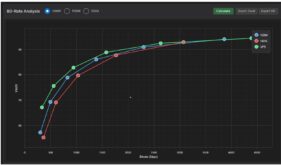
When a codec researcher declares that a newer codec is up to 40% more efficient than the baseline codec, they are making a highly accurate, well-defined claim. However, much like the EPA fuel economy ratings on a new car’s window sticker, these white papers should include a disclaimer stating, “actual bandwidth savings almost certainly will vary.” Given that bandwidth savings …
Read More »My Three Take Evolution in Vibe Coding
The marketing story around vibe coding is awe-inspiring: a non‑programmer can describe any app they can imagine, and AI will do all the hard work. No code, no problem. Just vibes. It turns out I was vibe coding before I ever heard the term. My goals were both less and more ambitious. Less ambitious, because I wasn’t trying to build …
Read More »Per‑Title Before New Codecs: Fixing Your H.264 Baseline
Before comparing your existing H.264 encodes to HEVC, AV1, or any other advanced codec, you need a baseline you can trust. In practice, many codec efficiency claims collapse once you examine how inefficient the underlying H.264 ladder actually is. This article focuses on fixing that baseline before any codec comparison begins. Let’s take a step back. This is the second …
Read More »Beyond H.264. Why Codec Choices Now Carry Legal and Financial Risk
Codec decisions used to be an engineering sport. Today, they are capital allocation decisions with legal risk attached. For most of the H.264 era, codec choices were technical and reversible: you ran some tests, watched the BD‑rate curves, and rolled out what looked best on your ladder. If it disappointed, you could back it out with little more than engineering …
Read More »Netflix’s Masterclass: Engineering Live Streaming at Scale
As a technologist and part-time couch potato, I appreciate Netflix on many levels. During the evening hours, it’s the creativity and breathtaking beauty of its productions. During working hours, it’s their technical contributions, like per-title encoding and VMAF, and their development and promotion of AV1. Unlike other publishers (cough, cough, Amazon), Netflix has always been amazingly gracious in sharing the …
Read More »
Streaming Learning Center Where Streaming Professionals Learn to Excel