 Streaming Learning Center Where Streaming Professionals Learn to Excel

Related Articles


The rise of AI-driven dubbing has created a fundamental shift in content localization. While some see it as an added expense, forward-thinking content producers and vendors increasingly recognize it as a strategic opportunity. By lowering costs, improving scalability, and unlocking new markets, AI dubbing is poised to deliver real growth for those who embrace it.
Contents
AI Dubbing Is Gaining Traction — and Driving Growth
Major platforms have already started leveraging AI-driven dubbing to expand their audience reach. Amazon Prime Video, for example, recently began testing AI dubbing on licensed content, adding English and Latin American Spanish dubs to 12 previously untranslated titles. Amazon described the effort as a way to “make content more accessible and enjoyable for viewers worldwide.”
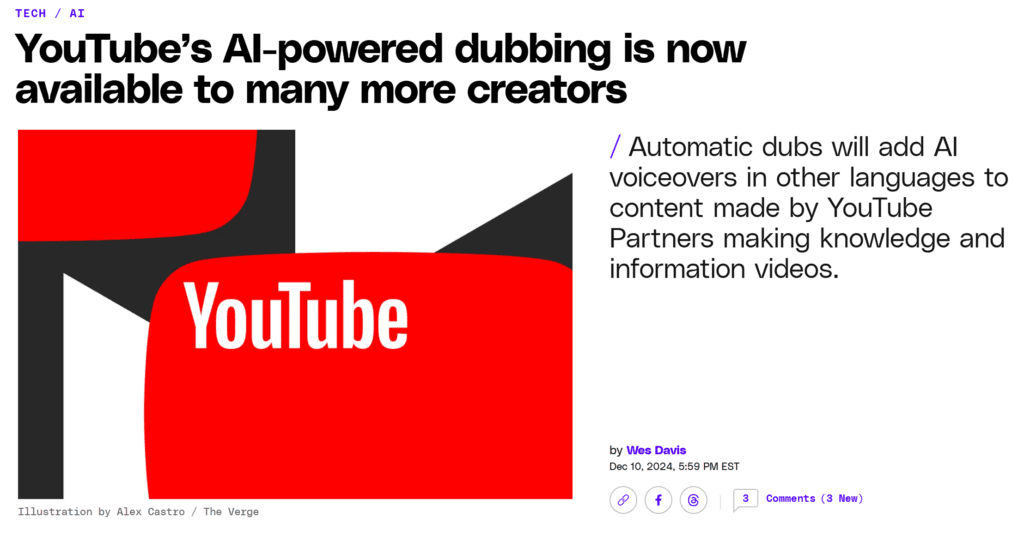
YouTube has also expanded its AI-powered auto-dubbing feature to “hundreds of thousands of channels,” positioning automated localization as a game-changing tool for creators. By allowing smaller content producers to deliver multilingual versions of their content without costly dubbing studios, YouTube’s move demonstrates how AI dubbing can drive audience growth without excessive overhead.
Interestingly, according to the Verge, YouTube has a fixed protocol that dictates which languages it will support and when. “If [the video] was in English to start, it’ll be translated into French, German, Hindi, Italian, Spanish, Indonesian, Japanese, and Portuguese. If the starting video was made in one of those languages, YouTube will only produce an English dub.”
Early Stumbles
Comments to the Verge article indicate that some early consumers don’t agree with the dictate that “perfect is the enemy of the good.” Commenter Concerned Rat observed that “I had some videos auto dub themselves to German and it’s some text to speech level stuff I would have expected from my laptop five years ago. It’s also annoying. I want to watch the video in English, not German. That’s why I clicked on an English video.”
Joneskind agreed. “And it’s awful. All of my beloved YouTube channels are now automatically dubbed in French and it’s an absolute pain.” Untoasted_m4ajdhto added, “I agree, it shouldn’t hurt to ask if I want that in the first place. I don’t get why it is so hard for Google to detach my current location to my default language of choice.”
These off-message results highlight an important distinction: AI dubbing isn’t flawless, especially in user-generated content (UGC) where audio quality varies widely. Unlike premium content with professionally mastered audio, UGC often gives AI models lower-quality input, which can reduce the effectiveness of automated dubbing. YouTube’s fixed language protocol may also frustrate viewers who prefer their original language selection — a reminder that user control is crucial in localization strategies.
However, these challenges shouldn’t overshadow the opportunity. Premium content producers working with clean, professionally produced audio are starting from a much stronger foundation, and AI dubbing tools should deliver far better results in those cases. Moreover, as AI models improve, the quality gap will shrink.
For UI designers, the takeaway is clear: provide viewers with intuitive controls to manage language preferences rather than forcing auto-dubbing by default.
Market education & validation
Would your product benefit from an independent technical analysis like this?
Our market education and validation service creates and distributes independent benchmarks, clear product explainers, and polished technical interviews. Proof that turns prospects into customers.
Learn how it works →Despite the early stumbles, the broader trend is undeniable — AI dubbing is advancing rapidly. Those who start integrating it into their localization strategy now will be better positioned to capitalize on improved quality and growing viewer demand. Sitting back and waiting for perfection risks being left behind as competitors expand their reach with scalable, cost-effective localization.
Education and Corporate Training
Beyond traditional entertainment and UGC, AI dubbing also opens new possibilities for educational content, corporate training, and niche genres that previously lacked localization options. With AI tools now preserving tone, slang, and emotion far more effectively than early automated dubbing models, the quality gap between AI-driven and traditional dubbing is shrinking rapidly. According to Verbit.ai, “AI-powered dubbing significantly reduces the time and financial resources required for localization.”
Encoding and CDN Vendors: A Value-Added Feature
For encoding and CDN vendors, AI dubbing presents an opportunity to add value to their services. Vendors that integrate automated dubbing solutions directly into their encoding workflows can help clients reach broader audiences while offering a differentiated service.
Supporting multiple audio tracks is no longer a niche feature. As platforms like Amazon and YouTube normalize multi-language options, vendors should treat multi-audio encoding as a core feature, not an add-on. AI dubbing enables this without requiring extensive manual intervention, and vendors that embrace these tools can position themselves as partners in audience expansion.
AI dubbing also introduces new bandwidth challenges, particularly when handling multiple audio tracks alongside video content. Encoding vendors that optimize for efficiency — particularly in adaptive bitrate (ABR) streaming — can provide meaningful value by helping clients minimize file size while still delivering multiple language options.
Localization Agencies: Scaling with AI Support
For localization agencies, AI dubbing isn’t a replacement for human translators but rather a tool to expand capacity. Agencies that integrate AI dubbing into their workflow can automate routine translations, freeing their human talent to focus on emotional nuance, cultural accuracy, and higher-value content. Rather than being displaced, agencies that leverage AI can increase output and improve efficiency.
Embracing the Opportunity, Not the Expense
The message for content producers, encoding vendors, and localization specialists is clear: AI-driven dubbing isn’t just a new cost — it’s a new opportunity.
Producers can expand their content’s reach without the prohibitive costs of traditional dubbing. Encoding vendors can offer enhanced services that attract media clients looking to scale globally. Localization agencies can boost efficiency and expand their offerings. Even UX designers have a role to play, ensuring viewers can easily switch between dubbed audio and subtitles for a seamless experience.
As AI dubbing tools improve and major platforms embrace the technology, those who invest in localization now will position themselves to capture audience growth, improve engagement, and unlock new revenue channels. The shift is already underway — and the opportunity is too big to ignore.