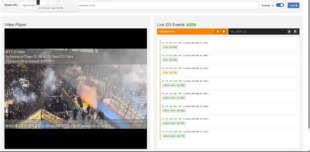
Wowza just released the Video Intelligence Framework, or VIF. According to my article in Streaming Media Magazine, VIF is an AI inference module that runs inside Wowza Streaming Engine, rather than in a separate NVR/VMS stack or a cloud video AI service. It samples frames from streams already flowing through the engine, runs them through computer-vision models on a local …
Read More »SBE Portfolio: Measuring BD-Rate and Break-Even Across a Full Library
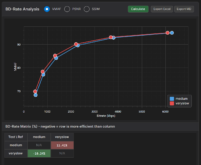
The new Portfolio feature in SLC Bitrate Explorer (SBE) version 2.0 aggregates BD-Rate and break-even results across multiple source files. This walkthrough covers the workflow from data entry to Excel export. Portfolios were NOT available in SBE version 1.0. If your version doesn’t show the portfolio buttons described below, you can upgrade to the new version below. This article was …
Read More »Cutting CDN Costs: A Conversation with CDN77
Recently, I sat down with Katerina “Kate” Dobnerova and Juraj Kacaba of CDN77 to discuss one of the largest recurring line items that every video publisher faces: CDN costs. By way of background, CDN77 is a video-focused global CDN that’s been in the market for 14 years, running a network with more than 300 Tbps of capacity and daily peaks …
Read More »The Correct Way to Choose an x264 Preset, Part 2: Your Audience Changes the Answer
Here’s the question on the table. x264’s veryslow preset delivers better quality than the medium preset but takes roughly 4x longer to encode, boosting your encoding costs by a healthy 4x (2-3x if using a cloud encoder). Which is the right preset for you, medium or veryslow? Like everything else in streaming, it depends. By way of background, in a …
Read More »Computing VMAF: How Missing Color Metadata Tanked the Score
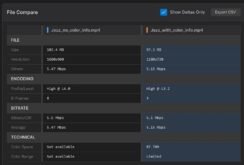
Developing a metrics tool is the easy part. Wire up FFmpeg, shell out to libvmaf, parse the JSON, draw a pretty line chart. It’s a weekend project, and the part they show you at vibe-coding camp. The part they don’t show you are the edge cases: the files that are a frame short, the variable frame rates that quietly drift, the …
Read More »How Fast Will AV2 Deploy?: Ask Joe Sixpack
The AV2 spec went final in late May 2026, AOMedia announced it on June 9, and VeriSilicon had a decode IP core out within about two weeks. An AOMedia member survey reports that 53% of respondents plan to adopt AV2 within a year and 88% within two years. Over the next several months, expect a steady stream of AV2 support …
Read More »Three Paths to Compression for Machine Vision: VCM, FCM, and the V-Nova Wild Card
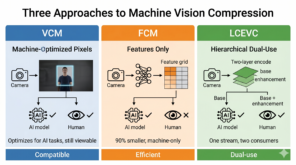
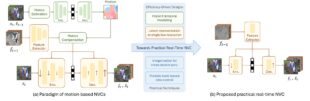
Video is increasingly captured primarily or exclusively for machine viewing, including applications like surveillance cameras, autonomous vehicles, industrial inspection, and drone footage. Traditional codecs like H.264 and HEVC were designed around human perception rather than machine vision tasks, which has opened the door to new compression approaches tailored to AI-driven workflows. Three emerging standards tackle this challenge from different angles: …
Read More »What Is Media over QUIC (MoQ) and Why It Matters for Real-Time Streaming
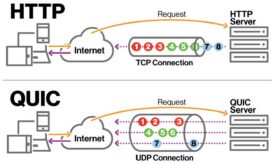
Live streaming has a fundamental tension that no existing protocol fully resolves. On one side sits WebRTC, which Ant Media describes as “ideal for real-time, interactive, low-latency communication like video calls, conferences, and interactive live streams.” On the other side sit HLS and DASH, which remain HTTP-based, CDN-friendly, and operationally mature at large scale, but practical low-latency variants still usually …
Read More »Comparing H.264, HEVC, VP9, and AV1 in SBE: From BD-Rate to Contextual ROI
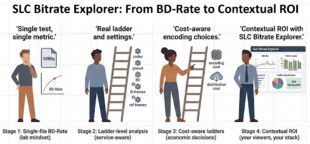
Most video engineers use a similar tool stack. MediaInfo for file data, Bitrate Viewer to view the bitrate of H.264-encoded files on Windows, Moscow State University VQMT on Windows for metrics, with a custom combination of data input scripts and Excel for RD curves and BD-Rate data. Most tools have critical gaps. Few let you compare videos during real-time playback, …
Read More »Emerging Markets for Video and Video Codecs
Executive Summary Most codec discussions orbit a familiar set of markets—consumer streaming, broadcast contribution, video conferencing—where the economics are well understood and the roadmaps relatively stable. But a growing share of the world’s video bits flow under constraints those markets don’t share: feeds that no human ever watches, downlinks measured in kilobits per second, latency budgets shorter than a frame, …
Read More »
Streaming Learning Center Where Streaming Professionals Learn to Excel