 Streaming Learning Center Where Streaming Professionals Learn to Excel

Related Articles
The AV2 spec went final in late May 2026, AOMedia announced it on June 9, and VeriSilicon had a decode IP core out within about two weeks. An AOMedia member survey reports that 53% of respondents plan to adopt AV2 within a year and 88% within two years. Over the next several months, expect a steady stream of AV2 support announcements, which will seem like momentum towards rapid adoption.
Here’s the fair way to read all of it, and it’s got nothing to do with compression ratios, licensing, or silicon roadmaps. No codec ever achieved fast adoption based on merit alone. Each accelerated adoption happened because there was a “lever,” a reason strong enough to accelerate the process. HEVC had a lever. H.264 had a lever. AV1 had the cleverest lever of all: YouTube withholding 4K from any player that didn’t support its preferred codecs, first VP9 and then AV1.
AV2’s problem is that a lever usually works only once, and by 2026 they’ve all been pulled.
Contents
The natural schedule is slow
Before exploring the accelerated adoption scenarios, let’s first look at the default path. Absent market-driven acceleration, every codec walks the same slow path shown in Figure 1 from an AOMedia launch presentation.
The spec finalizes, chip vendors build decode silicon, device makers design that silicon into TVs and phones, products ship, and the installed base of capable devices slowly accumulates. Only when that base crosses a threshold do mainstream publishers turn the codec on, because encoding and storing a second format costs money and delivers no ROI until enough people can play it. One InterDigital white paper pegged that threshold near 30% of the addressable base. Good enough.

When AOMedia launched AV1 in 2018, it forecast one year for silicon and two for consumer devices. That was optimistic even before COVID wrecked the supply chain, and AV1 missed it. Add the two to three years it takes for the installed base to reach 30% after devices ship, and the honest default is something like four to six years from a finished spec to a market a publisher will address. That’s the schedule when nobody is in a hurry. The interesting question is what ever makes anyone hurry.
HEVC: Consumers push adoption
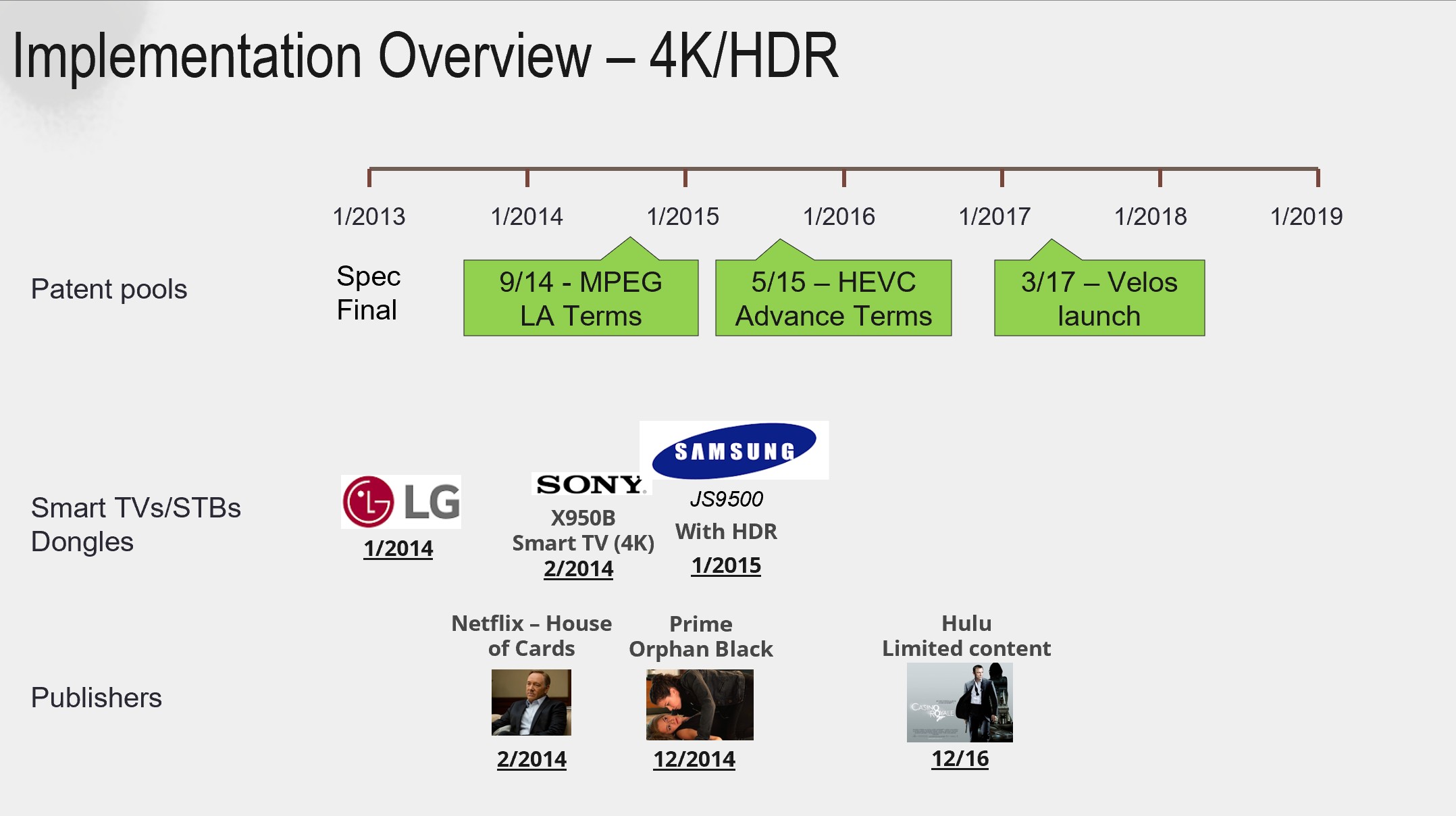
You wouldn’t know it from all the bad press, but HEVC is the fastest codec adoption on record. HEVC’s first edition was released at the end of January 2013. The 4K race was already the centerpiece of that month’s CES, two weeks before the spec even froze, with major brands showing UHD panels and HEVC demonstrated on the floor through external decoders. Those first 4K sets were panels without onboard HEVC decode, Sony’s 2012 and 2013 Bravias among them, so the earliest 4K HEVC decoding had to happen in outboard boxes. Sony cared enough to ship a dedicated one, the FMP-X5, in 2014, purely so its 4K sets could play Netflix in HEVC. Built-in decode appeared on some 2014 model-year Bravia 4K TVs.
In terms of publisher support, Netflix streamed 4K HEVC with House of Cards by April 2014, barely a year after the spec closed. A hardware race running ahead of a frozen spec, onboard decode the next model year, and a major publisher live inside fifteen months is only possible if chip development, silicon availability, and TV design-in were all running at once rather than in sequence. Penetration of HEVC-capable devices then climbed steadily toward near-universal adoption, according to one installed-base projection, rising from 57.5% in 2019 to 90.4% in 2023 and an estimated 99.6% by 2027.
In contrast, VVC went final in July 2020, and there still are few, if any, TVs with VVC decoding outside of Brazil, close to six years later. AV1 went final in March 2018, and some TVs with AV1 decoding appeared in mid-2020, though it took several more years for support to become pervasive in new models.
Regarding licensing, MPEG LA announced its HEVC license terms in September 2014. HEVC Advance announced its terms in 2015, while Velos Media launched in 2017. In essence, HEVC succeeded before the pools launched and all the complaints started. Penetration climbed straight through all three rounds of licensing turmoil without a wobble (Figure 3).
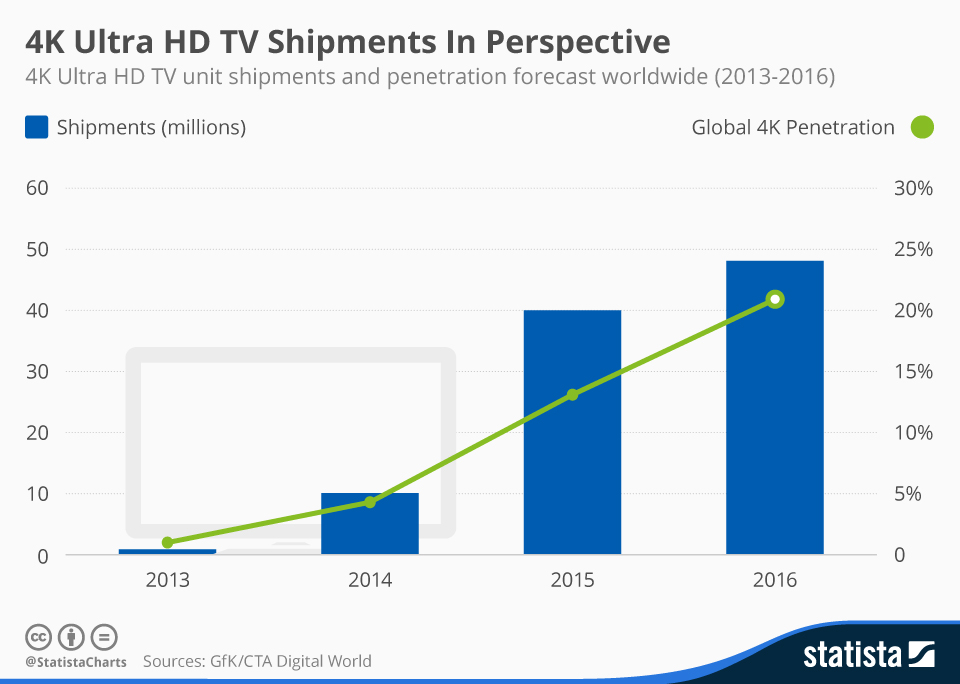
The reason was 4K, and then HDR. They provided a legitimate shiny new object that consumers walked into a store and wanted, and that sold new TVs. That pull accelerated deployment because no CE manufacturer wanted to be without a 4K set when a customer was willing to pay for it.
HEVC didn’t move fast because its logistics were fast. It moved fast because consumers gave the whole industry a reason to skip the waiting.
H.264: Publishers Push Adoption
Consumers are one engine. Publishers are the other, and H.264 is the clean example of publishers jumping.
In the late 2000s, web video meant Adobe Flash, and Flash reached the desktop browser and almost nowhere else. Then the screens multiplied. The iPhone shipped with no Flash, Android followed, smart TVs arrived with their own players, and HTML5 video appeared.
A publisher who wanted those audiences had no path through Flash. H.264 was the path. Once Adobe added H.264 to Flash, it became the one codec publishers could support and play everywhere, inside Flash, on iOS, on Android, on smart TVs, and in HTML5.
Publishers jumped at that, and adoption was rapid, not because of a consumer feature but because H.264 gave publishers access to markets they could not otherwise serve. The pull came from the supply side, and it was every bit as strong as HEVC’s consumer pull. A codec that expands a publisher’s reach gets adopted quickly. Hold onto that, because it is the test AV2 has to pass on the publisher side.
AV1: when YouTube and Netflix push adoption
AV1 is the model AV2 will be measured against in the living room, and the main lever was YouTube 4K (Figure 4).

The story starts with VP9. As reported in FlatpanelsHD in an article entitled, 2015 TVs will support YouTube in 4K by using VP9:
We first heard about Google’s efforts to bring VP9 – and with it, YouTube in 4K – to Smart TVs at CES 2014. The timing was odd because in 2014 no TVs actually supported VP9. That will change in 2015, where Samsung, Sony, LG, Sharp, and Philips TVs will be capable of streaming YouTube in 4K.
Google have chosen to go its own way in the pursuit of better streaming picture quality. Most industry players are betting on HEVC to replace mpeg4, but Google wants its own VP9 to succeed. So it has decided that YouTube will use VP9 for 4K streaming on TVs.”
It’s clear that had YouTube chosen HEVC, VP9 would have never have achieved these design wins. A few years later, YouTube started encoding its most popular videos in AV1.
Here the picture gets a bit muddled. Most likely, YouTube’s pitch to SmartTV vendors changed from, “to watch 4K videos, you must support VP9,” to “to watch our most popular videos at their best quality, you must support AV1.” Of course, you can’t drop VP9 support because most 4K videos are NOT encoded in AV1. In parallel, Netflix advanced its use of AV1, reinforcing the AV1 value proposition to include improved QoS and HDR; what SmartTV product manager could resist that?
Together, YouTube and Netflix, two AOMedia founders, created quite the value proposition. In a recent tech blog, Netflix reported that over the past five years (2021–2025), 88% of large‑screen devices, including TVs, set‑top boxes, and streaming sticks, submitted for Netflix certification have supported AV1.
The big question is, will AV2 create the same value proposition? It’s possible that YouTube could switch to AV2 for 4K/8K videos, duplicating the AV1 message, but consumers already get 4K with AV1.
That’s the catch with the cleverest lever: it works by withholding something people want, and you can only withhold a given thing once. YouTube already spent 4K on VP9 and AV1. There’s nothing left to hold hostage for AV2, and “support AV2 or miss our best videos at their best” is a hostage few will pay for when they already get 4K.
The thing you can’t trust: the survey
Codec surveys consistently over‑promise. A recent vendor survey, for example, shows AV1 in production at 17% of organizations with 40% more planning to deploy in 2026, implying 57% combined by year‑end, which are numbers that echo AOMedia’s own AV2 survey optimism. But five years of Bitmovin Video Developer Reports show a different reality: AV1 usage crept from roughly low‑teens to mid‑teens while “plan to deploy” numbers stayed far higher (Figure 5).
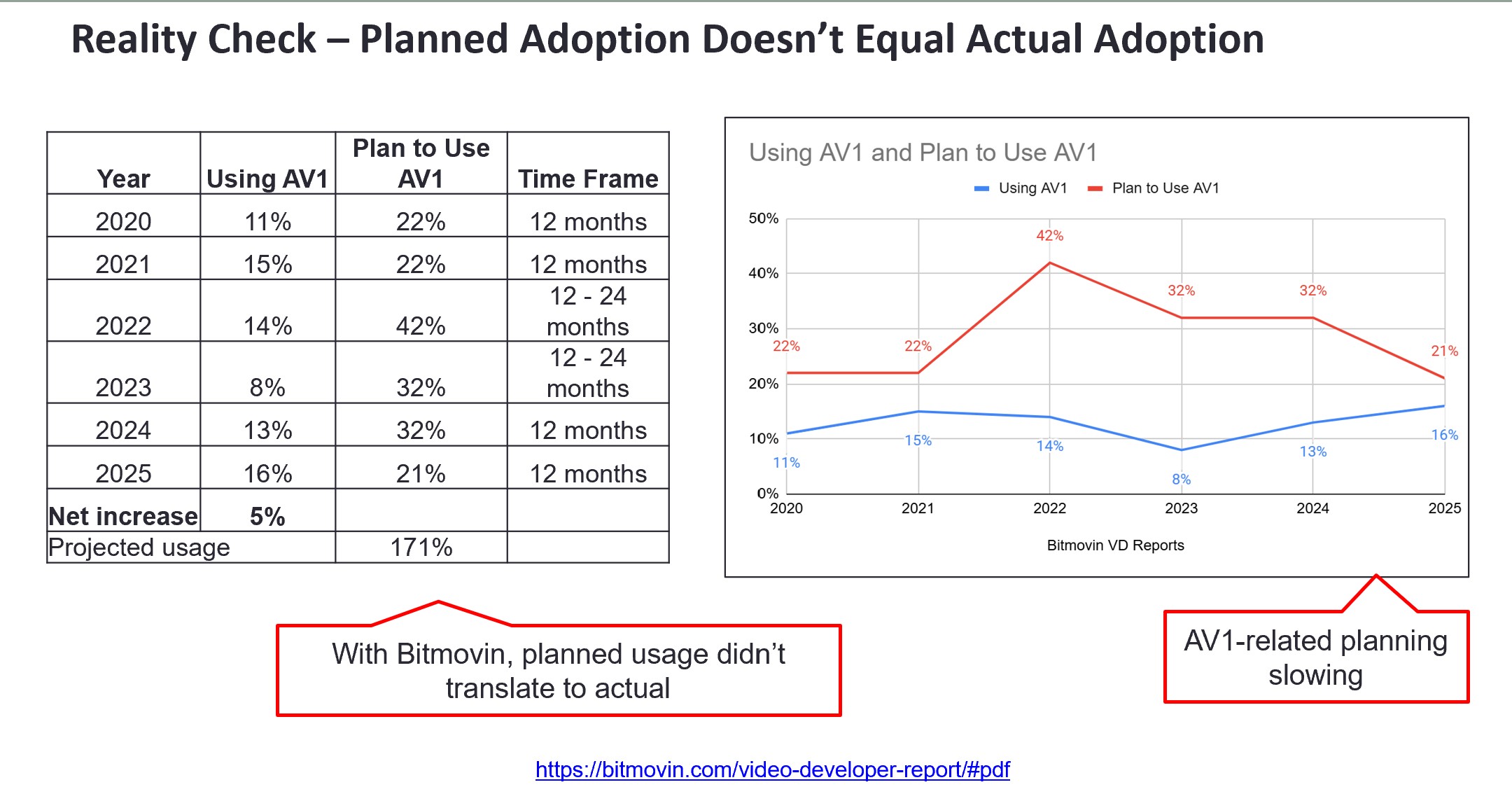
Figure 5 AV1 adoption predictions from the Bitmovin Video Developer Report.Don’t get me wrong; I find the data from Bitmovin reports extremely valuable (and you can complete the current survey here). But I’ve learned to consider the codec adoption data more as an indicator of sentiment than of true intent.
Does AV2 give anyone a reason to accelerate the adoption curve?
Put AV2 to the same test, and here’s the trouble: every lever’s already been pulled.
Will consumers jump? Ask whether any AV2 announcement would make Joe Sixpack want a new TV. AV2 delivers nothing he doesn’t already get from the HEVC or AV1 set in his living room. 4K is done, HDR is done; so there is no compelling reason for him to buy, and no consumer pull to compress the schedule the way 4K did for HEVC. YouTube and Netflix may (again) attempt to create that pull, but with YouTube 4K covered, it’s clearly less powerful.
Will publishers outside the AOM hyper-scalar club rush to AV2? The H.264 test was reach, and AV2 fails it. Every viewer an AV2 stream can reach is already reachable with a codec they already produce, so adopting AV2 doesn’t consolidate their encodes. Instead, it adds an encode, a storage tier, and a fallback path in exchange for some efficiency on the sliver of devices that can decode it.
Will Meta, Netflix, and YouTube rush to adopt? Without question, but if it’s anything like AV1, they won’t pull other publishers with them.
All that, and the end of the royalty-free fiction
Surveys measure intent, not deployed encoders or shipped TVs; when you see “88% will adopt AV2 within two years,” file it under sentiment, not forecast.
As compared to AV1, the 2026 royalty realities will hit AV2 disproportionately harder. When AV1 launched, the pitch featured “royalty‑free” language that persists to this day. The deliberate impression wasn’t “royalty‑free vis‑à‑vis AOM,” which is the narrow reality, but “royalty‑free, period.”
By 2025–2026, that illusion is gone, at least among the relevant decision-makers. Sisvel says its AV1 pool now covers roughly half of the finished‑product AV1 market and has already signaled it is “prepared” for AV2 with a follow‑on pool. AV1 is also in scope for the new Avanci Video and Access Advance Video Distribution programs, which offer one‑stop streaming licenses for HEVC, VVC, AV1, and VP9. Presumably, AV2 will be included as well.
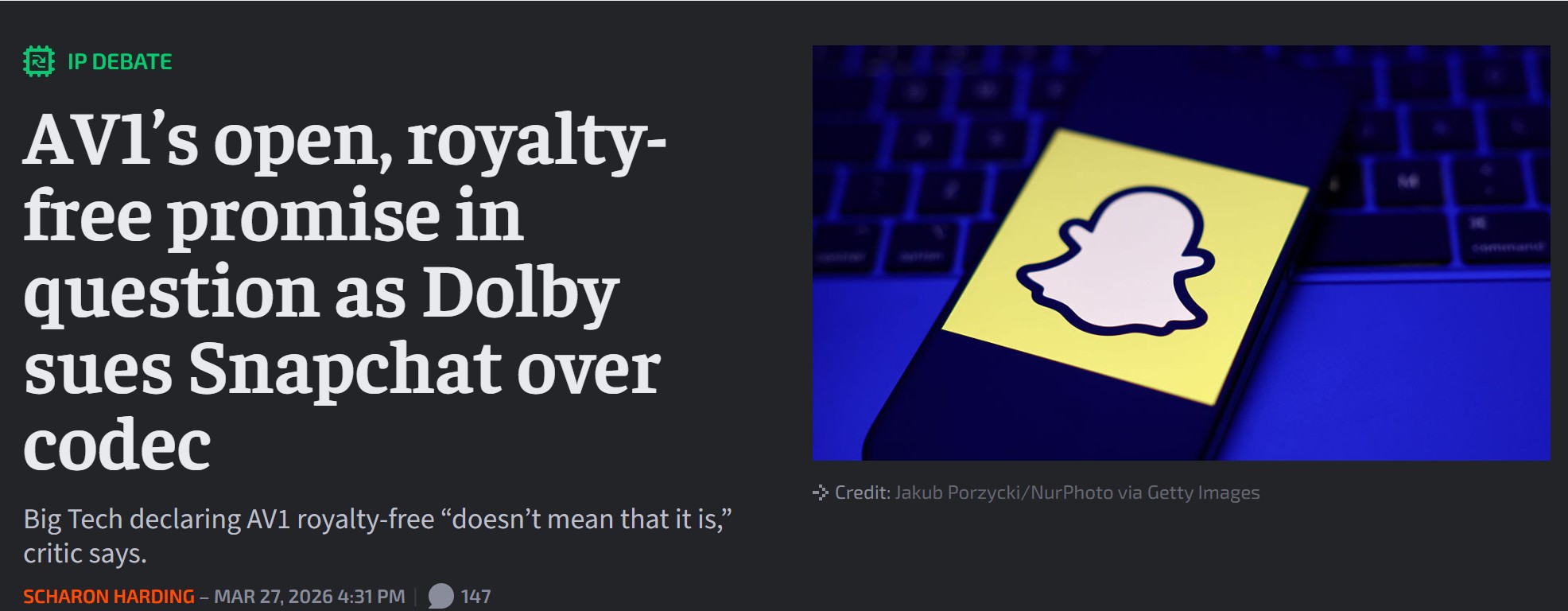
And Dolby is now suing Snap over alleged AV1 and HEVC patent infringement in the U.S. and Brazil, explicitly arguing that it has made no FRAND or royalty‑free commitments for AV1 (FRAND is Fair, Reasonable, and Non-Discriminatory). Ironically, because AV1 isn’t a standard created by a standard-setting organization, and because Dolby made no FRAND statement regarding AV1, royalties may not be limited by FRAND, so AV1 could be more expensive than other codecs like HEVC or VVC.
The bottom line is that the royalty-free posture that may have accelerated AV1 adoption is now gone, which may add friction to every implementation decision, hardware or content. As with HEVC, this friction could be overcome with a strong enough demand lever, but I don’t see that here.
So here is the realistic expectation, venue by venue.
- Browser support comes fast, call it twelve months, because the browsers are AOM-controlled and software decode ships in an update.
- Hyperscaler delivery to computers follows, maybe twenty-four months, serving AV2 to those software decoders where it costs almost nothing to try.
- And then it stalls, because the next venues need hardware. Mobile took Apple about five years to add AV1 silicon, and AV2 has substantially higher decode complexity in early software implementations, so software playback on a hundred-dollar phone looks doubtful, and mass-market hardware is a long, driverless wait.
- Smart TVs are further out still. Show me the pull that adds AV2 hardware decoding to mobile and the living room, and I will revise the timeline. I don’t see one.
So, the slog
None of this means AV2 fails. It’ll grab the cheap footholds, the browser and the hyperscaler desktop, within a couple of years. Essentially, the same places AV1 reached first, for the same reason: they cost almost nothing to try. AV1 didn’t fail, and VVC hasn’t failed. They’re slogging up the natural schedule on hardware cycles and a few committed giants, not on a wave of any strong lever. That’s the honest forecast for AV2 too, the same slog into mobile and the living room, paced by hardware generations, not survey horizons.
But notice what’s missing this time. HEVC had consumers. H.264 had publishers. AV1 had YouTube holding 4K hostage. Each of those levers is good for one pull, and all three have been pulled.
So when the support announcements roll in, ask yourself: would it make Joe Sixpack buy a new TV, or hand a publisher a market it can’t already reach? When the answer’s no, you already know how fast this goes. I’d love to be wrong. I’ve just watched this happen enough times to doubt that I will be.