Tag Archives: Codec royalties

Munich Court Proposes €1.05 Monthly Codec Royalty for Netflix Premium Subscribers

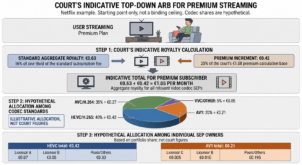
The 7th Civil Chamber of the Munich I Regional Court just published detailed FRAND guidelines addressing standard-essential patent licensing. The guidelines include an analysis of how the court might calculate video codec royalties for streaming services, with Netflix and Disney+ as examples. This was not a decision involving either company. In fact, the court noted that it has not yet …

Read More »

Codecs for CFOs

Executive Summary The H.264 codec has proven remarkably durable, but demand for 4K efficiency, HDR compatibility, and small-screen/low-bitrate quality makes adopting advanced codecs like VP9, HEVC, AV1, and VVC inevitable for most services. However, between 2022 and 2026, the economics of streaming codecs have changed materially. Tier‑1 OTT services that once paid $100K in H.264 content royalties may now pay …

Read More »

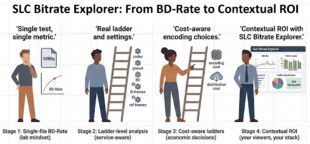
Comparing H.264, HEVC, VP9, and AV1 in SBE: From BD-Rate to Contextual ROI

Most video engineers use a similar tool stack. MediaInfo for file data, Bitrate Viewer to view the bitrate of H.264-encoded files on Windows, Moscow State University VQMT on Windows for metrics, with a custom combination of data input scripts and Excel for RD curves and BD-Rate data. Most tools have critical gaps. Few let you compare videos during real-time playback, …

Read More »

All Encoding Decisions Are Economic Decisions. It’s Time to Start Treating Them Accordingly

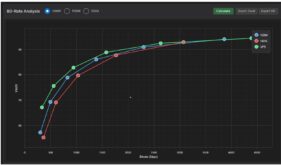
You think you know RD Curves. You think you know encoding ladders. I’m here to tell you, you don’t know diddly.  The RD Curve above compares encoding ladders for VP9, HEVC, and H.264. It’s a short, idiosyncratic clip. Don’t focus on what you know about codec efficiencies. Focus on what you think the RD Curves tell you.  Which codec is …

Read More »

Access Advance vs. Avanci Video: How the Streaming Programs Calculate Royalties

This report illustrates and compares the royalty calculations of two patent licensing programs, Access Advance’s Video Distribution Patent (VDP) Pool and Avanci Video, using eight streaming service templates modeled after well-known platforms. The purpose is to help streaming services understand how the two programs calculate royalties and compare potential royalty costs side by side. I believe that the best way …

Read More »

When There’s No FRAND: What Dolby’s Suit Against Snap Means for the Industry

On March 24, 2026, Dolby sued Snap Inc. (Snapchat) for AV1 and HEVC patent infringement in the United States and Brazil. The suits are the first AV1 assertion against a streaming platform by an Access Advance licensor, and Dolby is seeking injunctive relief in both countries. The reason this matters beyond Snap is a single legal fact: Dolby is asserting …

Read More »

Lies, Damn Lies, and Estimated Bandwidth Savings

When a codec researcher declares that a newer codec is up to 40% more efficient than the baseline codec, they are making a highly accurate, well-defined claim. However, much like the EPA fuel economy ratings on a new car’s window sticker, these white papers should include a disclaimer stating, “actual bandwidth savings almost certainly will vary.” Given that bandwidth savings …

Read More »

Beyond H.264. Why Codec Choices Now Carry Legal and Financial Risk

Codec decisions used to be an engineering sport. Today, they are capital allocation decisions with legal risk attached. For most of the H.264 era, codec choices were technical and reversible: you ran some tests, watched the BD‑rate curves, and rolled out what looked best on your ladder. If it disappointed, you could back it out with little more than engineering …

Read More »

Codec Royalties on Content and the Jaws Moment

I was raised in a beachfront commuter town about 60 miles south of Manhattan and five miles north of Springsteen’s Asbury Park. I went to Seashore Day Camp years 8-13, swimming laps in the pool each morning and clowning around in the ocean each afternoon. I spent middle school and high school in the Atlantic as often as possible, swimming, …

Read More »

Computing the payback period on ASIC-based transcoders

computing the payback period on ASIC-based transcoders

One of the most power-hungry processes performed in data centers is software-based live transcoding, which can be performed much more efficiently with ASIC-based transcoders. With power costs soaring and carbon emissions an ever-increasing concern, data centers that perform high-volume live transcoding should strongly consider switching to ASIC-based transcoders like the NETINT T408. To assist in this transition, NETINT recently published …

Read More »