 Streaming Learning Center Where Streaming Professionals Learn to Excel

Related Articles


Contents
Executive Summary
The H.264 codec has proven remarkably durable and affordable, but demand for 4K efficiency, HDR compatibility, and small-screen/low-bitrate quality makes adopting advanced codecs like VP9, HEVC, AV1, and VVC inevitable for most services. However, between 2022 and 2026, the economics of streaming codecs have changed materially. Tier‑1 OTT services that once paid $100K in H.264 content royalties now pay up to $4.5M per year for H.264 while advanced codecs are covered by multiple licensing programs and active patent enforcement campaigns that can easily reach tens of millions of dollars annually for larger services.
In this environment, the core question for finance and product teams is no longer “Should we use a new codec?” but “Which codec, for which workflows, under which license structures, and what does that do to EBITDA?” Many streaming organizations still evaluate codecs using vendor white papers or lab tests that don’t reflect the actual encoder used to produce the files, the encoding ladder structure, customer viewing patterns, encoding and distribution costs, or the range of other idiosyncratic factors required for accurate financial modeling.
This guide provides a practical framework to treat codec adoption as an intentional capital investment. It does three things:
- Establishes an optimized H.264 baseline as the financial benchmark for new codecs, showing how much bandwidth and cost you can remove before adding additional complexity or licensing obligations.
- Summarizes the current licensing landscape for HEVC, VP9, AV1, and VVC, including the role of patent pools and bilateral agreements in providing standardized access to standard‑essential technologies for streaming services and device makers.
- Quantifies the potential EBITDA impact of advanced codecs by combining compression efficiency benefits with revenue‑side gains from premium features and improved QoE, as well as changes in encoding, storage, origin egress, and patent royalty costs across realistic viewing ladders and device mixes.
For leaders who want an accurate and repeatable decision process, the guide outlines a capital allocation framework for codec selection. The framework starts with your current ladders, CDN costs, device footprint, and licensing posture; tests candidate codecs against your actual content and workflows; and models the total financial impact of new codec adoption. It also introduces the Codec Economics and Royalty Analysis engagement, which applies this methodology to your specific stack, traffic mix, and cost structure to produce a customized codec economics model and workflow‑level adoption roadmap that help your organization predict the EBITDA impact of advanced codec adoption in its key workflows.
By the end of the document, executive teams can:
- Audit their current streaming operations and codec‑related licensing posture within a single, coherent model.
- See where HEVC, VP9, AV1 and VVC do and do not clear their investment thresholds for key workflows.
- Decide whether to build codec economics capability in‑house or engage a specialist to run the analysis and support board‑level codec strategy decisions.
Introduction
The streaming industry has a love/hate relationship with new codecs. We love extolling new features and efficiency, but we often hesitate to deploy them at scale.
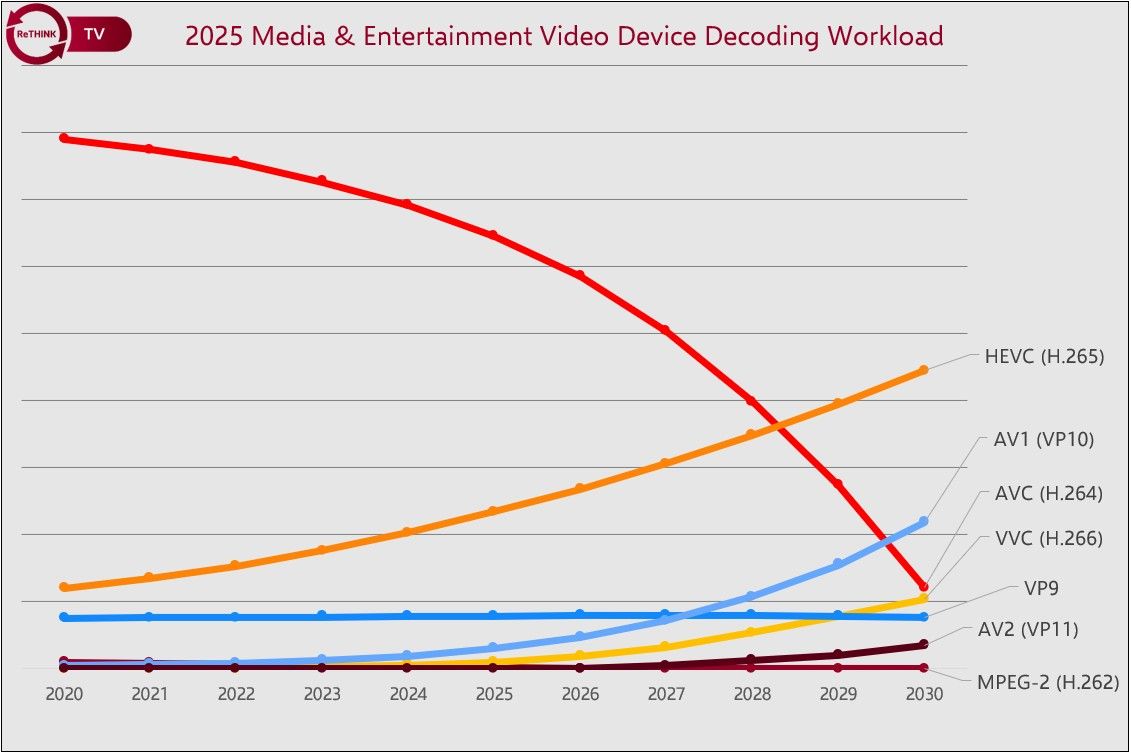
While H.264 has proved surprisingly durable, ReTHINK TV projects that its share of media and entertainment device decoding workload will steadily decline through 2030 as HEVC and AV1 assume a larger share of viewing. New codecs are not optional forever; they’re the rails your future 4K, HDR, and low‑bitrate experiences will run on.
What has changed in 2026 is not whether you will adopt HEVC, VP9, AV1, or VVC, but how you do it and what it costs. A Tier 1 OTT that once paid a $100K annual cap for H.264 now faces a materially different licensing stack. H.264 alone can reach $4.5M per year for new licensees; modern codecs can add tens of millions in potential pool and bilateral royalties on top of increased encoding and storage costs.
The question for finance and product is no longer “Should we use a new codec?” It’s “Which codec, for which workflows, on what terms, and what does that do to EBITDA?”
This guide assumes that advanced codecs are in your future. Its purpose is to help you choose the right codec for each workflow and to quantify the bandwidth, revenue, and royalty impact so you can deploy them as intentional capital investments, not speculative science projects.
What’s Below
If you manage a streaming platform, video compression is a core variable in your operational cost structure and legal risk profile. Most executive teams evaluate codecs using vendor-supplied white papers or isolated lab tests that fail to reflect production economics. This guide breaks down how codec selection directly impacts your bottom line, where traditional financial models fall short, and how to execute a defensible, risk-adjusted deployment strategy.
Here’s the roadmap for this guide.
- What Are Codecs and the H.264 Baseline: We detail the role that codecs play in streaming platforms, evaluate why H.264 remains the default benchmark, and break down the hidden operational costs and benefits of introducing advanced codecs like HEVC, AV1, and VVC into your workflow.
- The Modern Royalty Reality: We dissect the current patent landscape, moving past the myth of royalty-free codecs to map out pool structures and non-member standard-essential patent litigation exposure.
- Identifying the True EBITDA Impact of New Codecs: We examine the valid business drivers for new codecs, from revenue enablement through premium features to low-ladder quality improvements, while evaluating the challenges of realizing paper savings in production.
- A Capital Allocation Framework for Codec Selection: We outline a step-by-step decision matrix to audit your current baseline, test new codecs against actual content files, and model total financial impact.
- Introducing the Codec Economics and Royalty Analysis: For companies seeking help with this analysis, we are offering the Codec Economics and Royalty Analysis, which quantifies the true costs and financial impact of new codecs by running a comprehensive, customized analysis of your encoding stack, workflows, and cost structure.
By the end of this guide, you’ll have a practical framework to audit your current streaming operations, model royalty liabilities, and measure the true impact of adopting an advanced codec. You can apply this framework yourself, or ask us to run it with you through the Codec Economics and Royalty Analysis engagement.
Section 1. Codecs and the H.264 Baseline
Engineers naturally gravitate toward new compression technology because higher efficiency is an inherently attractive technical goal. Executive management needs that technology to make financial sense before committing capital. That fundamental disconnect between technical enthusiasm and financial reality is precisely where streaming platforms burn money.
As you almost certainly know, video codecs compress video for storage and delivery. They directly dictate how many bits you ship per second of viewing time, which directly drives your CDN bills. Because video distribution is a primary variable expense for streaming platforms, compression efficiency is a core financial lever.
The H.264 Universal Baseline
H.264 has been the universal workhorse codec for over two decades. It runs reliably on virtually every playback device, from modern smart TVs to decade-old mobile phones. It also carries a mature, predictable licensing structure.
For platforms that locked in their licenses early, content-related royalties peaked at $100,000 per year. However, in December 2026, the Via Licensing Alliance restructured its rate cards, replacing the legacy $100,000 cap with a tiered model that tops out at $4.5 million annually for Tier 1 platforms. Even with those increases for new market entrants, H.264 remains the established baseline against which all advanced codec investments are measured. Plus, in virtually all cases, it’s the one codec a service can’t operate without.
As such, H.264 is the baseline for calculating the financial impact of new codecs. To do so, you’ll compare the efficiency of the new codec against H.264 to compute bandwidth savings. To achieve the most accurate savings measure, start by making sure your H.264 encodes are as optimized as possible.
For example, many services still deploy H.264 using fixed-bitrate ladders. Moving to per-title or per-shot encoding often cuts H.264 delivery bandwidth by 15% to 25% with zero added licensing risk or infrastructure complexity. Switching to a higher quality H.264 preset may also deliver 5-10% savings. That optimized H.264 ladder establishes your true starting baseline. If you don’t optimize H.264, you’re almost certainly overstating the benefits of any additional codec.
The Advanced Codec Landscape and True Delivery Benefits
As we’ve discussed, newer codecs such as VP9, HEVC, AV1, and VVC promise better compression efficiency. The primary pitch for these modern codecs is that they can deliver identical visual quality at significantly lower bitrates than H.264. Most advanced codecs cite efficiency benefits that range from 30%-50%, which creates expectations that bandwidth savings will achieve the same levels.
Figure 2 shows BD-Rate comparisons between implementations of VVC (VVenC), AV1 (aomenc), HEVC (x265) and H.264 (x264). By implementations, I mean that there isn’t one H.264 codec; there is the H.264 codec and many implementations that vary significantly in terms of efficiency (see this article for a more extended discussion). This is one of the reasons that analyzing the potential bandwidth and cost savings delivered by the new codec must be performed using your actual H.264 encoder and the encoders you’ll use for the advanced codecs.
For the purposes of this article, the money column is x264 on the extreme right. According to my calculations at the time, VVenC could deliver the same quality as x264 at a bitrate savings of 58%. aomenc and x265 could do the same at bitrate savings of 49% and 30%, respectively.
You’ll notice I’m being very careful here; I’m not saying AV1 can deliver the same quality as H.264 at a 49% bandwidth savings. I’m saying the aomenc implementation of AV1 can save 49% as compared to the x264 implementation of H.264. This sounds arcane and picky, but it’s not. All implementations are different, and assuming that your encoder will deliver the same as a researcher’s is pure guesswork.
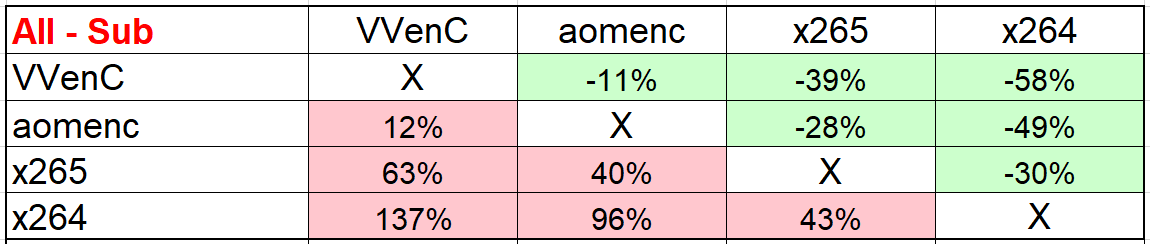
Still, working with the numbers in the Figure, assuming you were comparing aomenc to x264, would the actual bandwidth savings be 49%? Unfortunately not. Real-world bandwidth savings depend heavily on multiple factors; most importantly, the ladder rungs that your viewers retrieve. By way of background, video platforms deliver streams using an adaptive bitrate ladder, which offers multiple resolution and bitrate combinations ranging from low-resolution mobile tiers up to 1080p or 4K tiers.
If your audience mostly streams high-bitrate top rungs for display on large living room displays, advanced codecs deliver maximum dollar savings, but little quality enhancement. That’s because most encoding ladders are built to achieve a certain target quality for the top rung, irrespective of codec. So, the quality of the H.264 top rung should be similar to the HEVC top rung.
However, if your audience predominantly streams lower or middle rungs over mobile networks, the bandwidth savings shrink dramatically. Instead of retrieving and watching a 2 Mbps H.264 stream, the viewer retrieves and watches a 2 Mbps AV1 stream. Minimal bandwidth savings, but the AV1 stream should have substantially higher quality. That’s obviously beneficial, but if bandwidth savings is your KPI, you’re going to miss it.
The Operational Realities of Dual Deployment
Another factor to remember is that when you deploy a new codec, you still have to encode and deliver H.264 for devices incompatible with the new codec. Most platforms begin deploying an advanced codec once device compatibility across their user base hits roughly 30%. That means 70% of your traffic remains on H.264, making advanced codec deployment duplicative rather than a complete replacement.
Maintaining concurrent ladders for H.264 and an advanced codec requires dual encoding workflows and expanded cloud storage. In addition, splitting your audience across two separate codecs dilutes your content delivery network cache efficiency, so edge servers register fewer cache hits for identical content. This forces the delivery network to send more requests back to your origin shield, which inflates origin egress and infrastructure costs.
Finally, your net financial gain depends on your delivery architecture. If you rely on commercial content delivery networks with bandwidth-based rate cards, cutting bits on top-rung retrievals generates direct, immediate savings on your monthly invoice. If you operate a private edge network, such as custom caching appliances deployed inside internet service provider networks, raw bandwidth savings matter far less. For those private infrastructures, adding a new codec introduces heavy storage and re-caching costs across edge nodes with very little offsetting delivery savings.
For all these reasons, you can’t get a clear picture of the savings delivered by a new codec unless you consider all of these factors. But the most significant factor to consider is one that wasn’t a concern only three or four years ago. Specifically, patent royalties on streaming footage delivered using these new codecs.
Section 2: The Royalty-Free Myth Is Dead: AV1 is Now a Litigation Target
Let’s review a brief history of codec licensing, concluding with where we are today.
As mentioned, through 2025, H.264 streaming was capped at $100K for licensed publishers, grandfathered for streaming publishers who had a previous license with VIA LA. HEVC and VVC launched with royalties on decoders but no royalties on streaming content. The Alliance for Open Media (AOM) launched AV1 as a royalty-free codec, but that turned out not to be true. The bottom line for streaming publishers was that through 2022 or so, you could use VP9, HEVC, AV1, or VVC for streaming, and the only cost was $100K for H.264.
Since then, a lot has happened. Appendix I summarizes how codec‑related content royalties evolved from a low‑risk background issue into a central financial exposure for streamers, and how AV1 moved from “royalty‑free” marketing to clearly royalty‑bearing status.
Summarizing Litigation and Pool Formation
From 2018 through 2023, the Netflix versus Broadcom dispute in Germany showed that internet streaming itself is within enforceable patent scope. In September 2023, the Munich Regional Court ruled that Netflix infringed a Broadcom HEVC patent and issued an injunction that prohibited Netflix from using the patented technology in Germany. In December 2023, the same court fined Netflix €7.05 million for continuing to use that technology in violation of the injunction. Netflix later prevailed by invalidating the patent, but the case still demonstrated that courts are willing to enjoin and fine streaming services over codec and streaming implementations.
Beginning in late 2023, two major streaming‑side patent pools and multiple bilateral campaigns reshaped the landscape. In October 2023, Avanci launched the Avanci Video program as a single license for internet streaming services that covers AV1, HEVC, VVC, VP9, and MPEG‑DASH. In January 2025, Access Advance launched its Video Distribution Patent Pool, or VDP, to provide a comparable streaming‑focused license for HEVC, VVC, AV1, and VP9 and explicitly treated both past and ongoing streaming as royalty‑bearing. Together, these programs legitimized the concept that internet video streaming with modern codecs is a royalty‑bearing activity and provided structured ways for patent owners and streamers to price that usage.
Between 2023 and 2024, Nokia also reported multiple confidential license agreements with unnamed leading video streaming platforms, indicating that at least three large services had already taken portfolio licenses beyond Amazon and reinforcing that streaming royalty payments were becoming a routine cost of doing business.
At the same time, other individual patent owners began to pursue large streamers directly. In February 2025, InterDigital sued The Walt Disney Company and its Disney+, Hulu, and ESPN+ services in the United States, Germany, Brazil, and at the UPC over alleged infringement of video compression patents used in large‑scale streaming. In March 2025, Nokia and Amazon reached a global patent agreement that covered Nokia video technologies used in Amazon’s streaming services and devices, including Prime Video and Twitch, and resolved litigation in the United States, Germany, India, the United Kingdom, and the UPC.
On November 10, 2025, InterDigital launched worldwide enforcement actions against Amazon over video compression and HDR streaming patents, targeting Prime Video, Fire TV, and related devices in the United States, Europe, Brazil, and before the UPC, and in June 2026 Amazon took a license and agreed to arbitration to set the royalty rates. Nokia also filed streaming patent suits against Warner Bros. in November 2025, Paramount in August 2025, and Acer in April 2025, and in March 2026 Nokia and Warner Bros. settled. These actions showed that large services are now expected to take portfolio licenses and that stream‑side usage of video technologies is treated as royalty‑bearing.
In early 2026, more services entered the pools, and AV1 litigation arrived. In January 2026, Roku joined the Access Advance Video Distribution Patent Pool as a licensee, indicating that a major United States streaming platform had affirmatively taken a distribution‑side codec license that recognizes its streaming content as royalty‑bearing under the VDP structure.
On March 24, 2026, Dolby Video Compression LLC sued Snap Inc. in the United States District Court for Delaware and in Brazil over AV1 and HEVC patents administered through the VDP pool. This was the first AV1 lawsuit against a streaming or social platform by a VDP licensor and underscored that AV1 implementations by streamers are now direct litigation targets rather than being shielded by claims of royalty‑free status.
On July 2, 2026, Meta Platforms, along with Alibaba, joined the VDP pool for streaming across its social and video properties, demonstrating that advertising‑supported social video, reels, and live streams that use AV1, HEVC, VVC, and VP9 are treated as royalty‑bearing uses and confirming that internet video distribution is now a defined licensing domain.
The appendix also traces AV1’s specific path from “royalty‑free” fiction to royalty‑bearing reality. On the device side, Sisvel launched AV1 and VP9 patent pools in March 2019 covering consumer display and non‑display devices, explicitly focusing on hardware decoders and excluding encoded content and non‑physical distribution. On May 27, 2020, Sisvel announced Mitsubishi Electric and Tremmen Tecnologica as its first AV1 and VP9 licensees. By July 2025, Sisvel reported that approximately 50 percent of AV1 finished products on the market were licensed under its AV1 pool, showing that AV1 hardware implementations had become meaningfully royalty‑bearing.
On the streaming side, Avanci Video’s launch in October 2023 and the Access Advance VDP launch in January 2025 both included AV1 among their covered codecs for internet streaming services. Meta’s July 2026 decision to join the VDP pool for its AV1‑ and VP9‑heavy social platforms made it clear that this Alliance for Open Media founding member and heavy AV1 user and promoter considered AV1 streaming as a licensable, royalty‑bearing activity.
These events document how the industry moved from a 2022 environment where streaming with advanced codecs was assumed to be royalty‑free to a 2026 environment where streaming content using HEVC, VP9, AV1, and VVC is almost certainly royalty‑bearing. They also make clear that AV1 is no longer credibly described as royalty-free for either devices or streaming services.
Putting the timelines into a GAAP lens
For most commercial streaming services using VP9, AV1, HEVC, or VVC, codec/content royalties are no longer a speculative risk; they are an expected cost of doing business that you can and should model. In addition, the “royalty‑free AV1” narrative is no longer defensible.
From a GAAP standpoint, if you are a material streaming publisher relying on these codecs, it is hard to argue that codec/content royalties are merely “possible” or “remote”; they are both probable and estimable enough that they should be in your forecast and, for some, accrued as an expense.
Beyond GAAP reporting, the sooner streamers take these royalties into account, the sooner they can accurately price their services and project earnings. In 2026, content royalties for codecs are as real as power, personnel, and any other expense that normally makes its way into your financial reporting.
Two main royalty sources for streamers
You probably figured this out from the timeline, but it’s worth emphasizing. If you’re streaming with VP9, AV1, HEVC, or VVC today, you face two broad categories of royalty exposure. First are the Access Advance and Avanci programs, and second are individual patent owners like Nokia and InterDigital.
Note that the two pools contain a large percentage of common patents, so few streamers will license from both companies. The preferred strategy will be to license with one pool and then license individual patent owners to fill in any gaps. Both pools have published their rates, and you can find a rate comparison here that explores the royalty calculation with lots of examples. Notably, the Access Advance pool has a de minimis exception in the form of a $50,000 annual credit that should exclude most schools, churches, and corporations from the pool, but Avanci does not.
As you can see from the description, the individual patent owners are tackling the deep-pocket streamers like Netflix, Snap, and Amazon first. Their plans for attacking smaller publishers aren’t clear at this time. Nor are the settlement amounts made public. So, while the program-based obligations are reasonably estimable, those from individual patent owners are not at this point.
Section 3. Identifying the True EBITDA Impact of New Codecs
Identifying the True EBITDA impact of new codecs means attempting to quantify all benefits and costs, a task that often seems easier in theory than in practice.
The Commercial Benefits
The value generated by a new codec falls into three financial categories.
1. Revenue Enabling
For many premium platforms, like Netflix, Hulu, Prime Video, and Disney+, 4K/HDR has long been a competitive necessity. HEVC’s 10‑bit and 4K support, plus its roughly 40 percent efficiency gain over H.264, make it the practical baseline for premium UHD and HDR streaming on TVs and modern devices. If you’re in this class of service, an advanced codec is table stakes, irrespective of the royalty costs.
As you can see in Figure 5 from an InterDigital report released in mid-2023, HEVC with HDR became standard for services that focus on fresh high-impact content and modern devices. H.264-only stacks remained mostly on services that lean on older HD libraries, which often lack HDR masters.
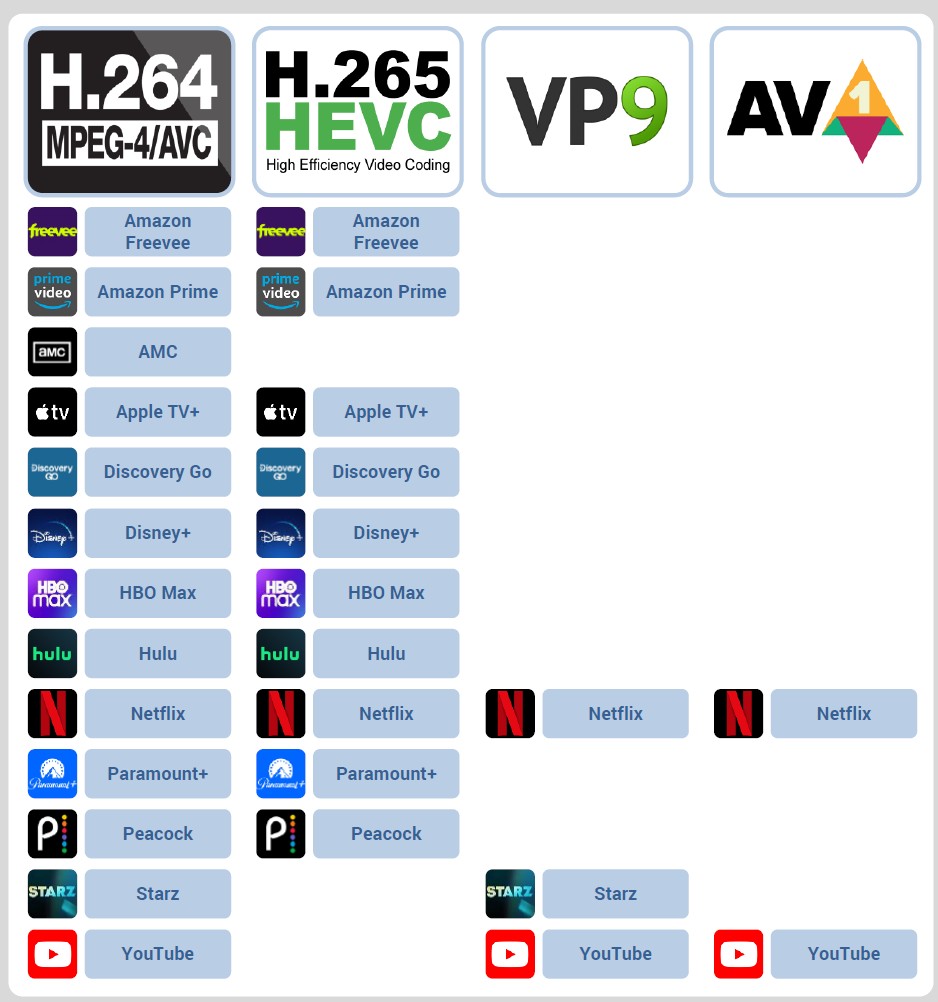
Back in 2023, AV1 HDR coverage was nascent, so HEVC was the only practical alternative. That picture has changed. In December 2025, Netflix reported that around eighty-five percent of its HDR catalog, measured by viewing hours, was available in AV1 with HDR10 Plus, and that “this number is expected to reach 100% in the next couple of months.” In the same report, Netflix shared that 88% of new living room devices it certifies now support AV1 playback up to 4K60.
It’s obviously up to the service to decide whether to deliver HDR with HEVC, AV1, or both. Whatever that decision, for this class of publisher, HDR is essential, and it can’t be effectively supplied with H.264.
When valuing the financial impact of HDR, note that several services offer exclusive tiers for the 4K/HDR experience. Most notably, Netflix’s Premium tier costs $26.99, a $7 premium over the next closest tier. Though there are other differences between the two services, like the ability to watch simultaneously on more devices, 4K/HDR is a very significant chunk of that premium, a clear indication of its value.
2. Revenue Retention
Beyond charging more for 4K/HDR content, advanced codecs deliver higher-quality video at lower bitrates, which offers several advantages that may help retain subscribers and users. For example, Netflix reports that AV1 now powers approximately 30% of its streaming on supported devices, and that AV1 delivers higher VMAF scores at roughly one-third less bandwidth than older codecs, along with fewer buffering interruptions. In A/B tests on 4K, Netflix also saw about a 5% increase in 4K viewing hours and 38% fewer noticeable quality down‑switches, which ties codec efficiency directly to how long people actually watch.
Meta tells a similar story for Facebook and Instagram Reels. Internal tests show AV1 reducing video bitrates by around 30 percent on average at comparable visual quality. In some examples, Meta achieved similar quality at roughly 65 percent lower bitrate than AVC and 48 percent lower than VP9. That level of efficiency obviously matters when you are serving billions of short videos a day over mixed networks.
Estimating the Benefits of Churn Reduction
While no major streaming service has published a direct empirical study proving a causal line from codec adoption to reduced subscriber churn, product teams can model the financial uplift using standard retention economics. To build a realistic model, isolate the specific audience segment affected by the upgrade.
Consider a service with 10 million subscribers and a $10 monthly average revenue per user. If 30 percent of your audience streams on devices compatible with a new codec, your target pool is 3 million users. If roughly 20 percent of those users routinely face network constraints where low-rung performance prevents buffering, your addressable cohort is 600,000 subscribers.
If improved low-ladder performance reduces monthly churn within that specific cohort by 0.5 percentage points, you retain 3,000 subscribers per month who otherwise would have canceled. At $10 per month, retaining those users generates $30,000 in saved monthly revenue, or $360,000 in annualized baseline top-line retention.
3. Bandwidth Savings
As we’ve discussed, bandwidth savings vary based on multiple factors, including:
- The resolution of your encoded videos (advanced codecs are more efficient with larger resolution videos).
- The codec implementation you’re using.
- The efficiency of your encoding parameters.
- Which ladder rungs are retrieved by your viewers.
- Encoding and distribution costs.
- Cost structure of your delivery network.
Bandwidth savings can be modeled and calculated with some precision, provided you take into account all the factors discussed above. The biggest mistake to avoid is assuming that top-line savings claimed by the codec developers actually translate to a direct reduction in your bandwidth bill. While this can happen in some instances, it’s far from the expected result in most others.
The Operational Costs
The commercial benefits of a new codec are offset by three main operational expense areas.
A. Infrastructure Expansion and Cache Degradation
Because H.264 must remain in your pipeline for legacy devices, adding a new codec requires running concurrent adaptive bitrate ladders. Since advanced codecs are often more complex than H.264 encoding, encoding will be substantially more expensive than H.264. You’ll also have to encode long-tail videos in your catalog to the new formats, creating another potentially significant catch-up expense.
You’ll also have to store the videos encoded in the new format, again in addition to the H.264 encodes. This expense should be smaller than current H.264 encodes because the new codecs are more efficient.
Splitting your audience across dual codecs fragments content delivery network edge caches. To maintain the same cache hit ratio, your delivery network must store twice as much content at the edge. Otherwise, cache misses increase, forcing more origin shield requests and driving up egress charges.
B. Integration, Testing, and Engineering Overhead
Deploying a new codec introduces significant upfront engineering friction. Player integration, quality assurance testing across device profiles, automated fallback logic, and manifest customization all require dedicated internal development resources. As there is with H.264, there will also be a continuing cost to support devices playing the new codecs.
C. Patent Royalty Liabilities
Certainly, the newest and potentially the highest cost will be patent royalty obligations. Again, while pool-related royalties are relatively simple to estimate, all royalty settlements in suits by individual patent holders like Nokia, InterDigital, and Dolby have been confidential.
As these companies target smaller organizations, they may create and publish rate cards or the equivalent, but to date these don’t exist. Presumably, royalty settlements have been customized according to the same inputs that drive pool-based royalties, including subscribers, users, and streaming revenue.
Why Back-of-the-Envelope Math Fails
Balancing these benefit streams against multi-layered operational costs creates an intricate financial matrix. Calculating true net impact requires modeling viewer device density, network transit conditions, ladder retrieval dynamics, origin shield egress penalties, and contingent royalty liabilities simultaneously.
Because these variable factors interact, simple back-of-the-envelope financial estimates routinely fail to reflect production reality. Certainly, the standard “30% – 50% bandwidth savings” has little relation to reality.
Which codec is “right” for which workflow?
There is no single “best” codec for every service. Different codecs tend to be the right choice for different combinations of devices, workflows, and business goals. The table below summarizes the likely front‑runner codec for common scenarios, assuming today’s device support and licensing realities.
| Workflow / Use case | Consider | Why |
|---|---|---|
| 4K HDR movies & series (premium SVOD) | HEVC | Broad 4K/HDR device support, proven deployments, feasible bitrates for consumer networks. AV1 feasible but has much less support in pre-2024 devices. |
| 4K HDR live sports | HEVC, VVC (early) | HEVC for current devices with more extensive living room support than AV1; VVC emerging for future HFR/HDR with better efficiency. |
| HD SVOD with strong TV/device footprint | HEVC | Best TV/STB coverage; meaningful savings on high‑bitrate top rungs vs H.264. |
| Mobile‑first / constrained networks (HD or lower) | HEVC or AV1 | HEVC has much more extensive hardware support in mobile devices, which means smoother playback and lower power draw. AV1 has superior low-rung efficiency and QoE on compatible phones/browsers; strong support in major apps. |
| Browser‑centric desktop / CTV apps | AV1, VP9 | AV1 where decode coverage exists; VP9 as a pragmatic fallback where AV1 isn’t yet universal. |
| Social/UGC short‑form video | AV1 or HEVC | Large MAU bases, heavy mobile usage; small quality/bitrate gains translate into big CDN savings. But hardware HEVC playback is much more prevalent than AV1, so it will consume less battery life and play more smoothly on low-end phones with HEVC hardware. |
| FAST/AVOD HD channels | HEVC, AV1 (case‑by‑case) | HEVC offers more complete coverage with and without HDR. AV1 offers greater potential savings on top rungs. |
| Future‑looking 8K / high frame‑rate workflows | VVC | Designed for higher resolutions and frame rates; currently limited by nascent playback support. Worth exploring for closed-loop deployments where the service provides the STB to the customers. |
A warning: Ask 20 encoding professionals to complete this table, and you’ll get 20 different answers. The suggestions in the table are just that, not commandments handed down by a compressionist deity and carved into stone. Choosing the right codec for your service and application requires a detailed look at all aspects of your service, from content to audience, including the devices and networks used to watch your content. In virtually all cases, H.264 remains mandatory as the universal baseline; most services will run it alongside at least one advanced codec for many years. The practical question is which additional codec to introduce first in each workflow.
The Codec Economics and Royalty Analysis engagement is designed to answer the “which codec, where?” question for your platform by combining objective codec measurements with your actual encoding costs, CDN pricing, traffic mix, and royalty exposure, so that each adoption decision is a quantified capital choice rather than an article of faith.
Section 4. A Codec Investment Decision Framework
Once you accept that codec decisions are financial and licensing decisions, not just engineering preferences, you need a repeatable way to decide whether a new codec merits investment. This section presents a seven‑step codec investment decision framework that you can apply to your own workflows. Each step has a clear purpose and outcome, so codec choices can be evaluated alongside other capital investments.
Step 1 – Define representative content. Choose your test clips
- Base your findings on a set of representative clips from your own libraries.
- Select 3–5 clips across relevant genres (sports, prime time, news, animation) and choose 2–3 minute segments for testing.
Purpose: Make sure all measurements reflect the content and viewing mix that actually drive your economics.
Step 2 – Establish an optimized H.264 benchmark. Optimize your H.264 baseline
- Review your encoding ladder, presets, rate control, and per‑title/per‑scene practices; make H.264 as efficient as reasonably achievable in your current stack.
- Set top‑rung quality as the target for encodes using the advanced codec, then transcode the reference clips to your full H.264 ladder.
Outcome: A clean, optimized H.264 baseline that improves ongoing operations and provides the financial benchmark for evaluating new codecs.
Step 3 – Design and benchmark advanced codec ladders. Assess planned advanced codec implementations
- Design ladders for candidate codecs (VP9, HEVC, AV1, VVC) that match H.264 top‑rung quality using objective metrics and visual checks.
- Tune encoding configurations for maximum efficiency and transcode the test clips to the full ladder for each advanced codec.
Outcome: Comparable ladders and encodes for each candidate codec, enabling direct analysis versus the optimized H.264 baseline.
Step 4 – Quantify benefits: bandwidth savings, revenue, and customer retention.
- Measure bitrate and quality across H.264 and advanced codec encodes; compute bandwidth cost reductions based on your CDN rates and actual ladder retrieval distributions.
- Estimate revenue upside from enabling 4K/HDR or other premium features, and model QoE‑driven retention/engagement improvements (e.g., lower churn, higher watch time and ad yield for cohorts primarily on lower rungs).
Outcome: A quantified view of both cost savings and top‑line benefits attributable to each codec in each workflow.
Step 5 – Quantify incremental operating costs. Estimate increases in operating costs
- Calculate additional encoding and storage expenses associated with running dual ladders and re‑encoding long‑tail catalog content.
- Assess impact on cache efficiency at edge locations and origin egress, along with other implementation costs (player integration, QA, ongoing device support).
Outcome: A full view of operational cost changes, not just headline bandwidth savings, so you can see true net OPEX impact.
Step 6 – Model licensing and royalty obligations. Estimate royalty obligations
- Estimate potential obligations under relevant streaming‑side licensing programs for modern codecs, based on your subscriber base, traffic volume, and usage patterns.
- Identify major patent owners outside those programs that actively license video compression and streaming technologies and consider likely exposure and license options if you deploy.
Outcome: A scenario‑based view of codec‑related licensing and royalty costs aligned with your expected usage and revenue.
Step 7 – Compute EBITDA impact and investment case. Compute the impact on EBITDA.
- Net all benefits and costs, including bandwidth savings, premium‑feature and QoE‑related revenue gains, incremental operating expenses, and licensing/royalty costs, to estimate codec impact on EBITDA for the workflows in scope.
- Express results as codec impact per subscriber or monthly active user, and as a percentage of streaming revenue for those workflows.
Outcome: A risk‑adjusted investment case for each codec/workflow combination, showing the financial impact of deploying an advanced codec.
Section 5. The Codec Economics and Royalty Analysis
With AV1, HEVC, VP9, and VVC all under active licensing programs and individual patent campaigns aimed at major streamers, content royalties are now as real as power and payroll. They should be part of your codec business case from the beginning, not an afterthought discovered by legal after deployment.
A healthy codec strategy for a streaming executive works as follows:
- H.264 remains the indispensable baseline, tuned as aggressively as your devices and tools allow. It is the reference point for measuring incremental savings and incremental risk.
- Advanced codecs are analyzed based on their ability to enable additional revenue (4K/HDR tiers, premium positioning), improve retention, or deliver net savings after royalties and operational costs.
- Royalty exposure is treated as a probable, reasonably estimable expense, modeled alongside CDN and encoding costs rather than ignored until litigation or pool demands force a reactive response.
As deploying advanced codecs becomes increasingly inevitable, streaming organizations need a formal, comprehensive process to model how these codecs will affect their financial statements. If your current codec roadmap does not yet incorporate economic and royalty analysis, you have two options. You can build the capability in-house, or you can bring in a specialized third party. With deep experience in codec performance, streaming cost modeling, and royalty computations, the Streaming Learning Center is well positioned to perform this analysis or work alongside your internal team.
Appendix I: Evolution of Content Royalties and AV1 Royalty Status
2019–2023: Foundations and early streaming disputes
2018–2023 – Netflix vs Broadcom in Germany (Broadcom win at first instance) – A German court finds that Netflix infringes a Broadcom patent related to streaming technology and orders Netflix to stop streaming content in Germany using the infringing technology, later imposing a €7.05M fine for continued infringement.
The case is a key data point that internet video streaming falls squarely under enforceable patent rights; streaming services can be enjoined and fined for codec/streaming infringements. Note that Netflix ultimately won this case by proving that the patent was invalid, but that doesn’t change the fundamental exposure of streaming platforms to patent claims around codecs and delivery technologies.
Late 2023–2026 – Content Pools, Bilateral Licenses
October 2023 – Avanci launches Avanci Video – Avanci announces Avanci Video, a comprehensive patent license targeting internet video streaming services and covering multiple video standards (including AV1, HEVC/H.265, VVC/H.266, VP9, and MPEG‑DASH). This marks the first major one‑stop “streaming content” pool, explicitly framing the use of modern codecs in commercial internet streaming as royalty‑bearing.
2023–2024 – Nokia announces several anonymous video‑streaming settlements – In Nokia communications around its video licensing campaign, Nokia references multiple license agreements with unnamed “leading video streaming platforms,” indicating a series of confidential settlements beyond Amazon, with at least three such anonymous licensees noted in public commentary. These deals reinforce that large streaming services are quietly taking portfolio licenses for video technologies rather than litigating to judgment, making streaming royalty payments a de facto cost of doing business.
January 2025 – Access Advance launches the Video Distribution Patent (VDP) Pool – Access Advance launches its Video Distribution Patent Pool to provide a one‑stop license for internet streaming using HEVC, VVC, AV1, and VP9, explicitly aimed at “video streaming services” and “video distribution.” This confirms that past and ongoing streaming of AV1/HEVC/VVC/VP9 content is viewed as royalty‑bearing and subject to retroactive claims that can be waived contractually.
February 2, 2025 – InterDigital sues Disney (Disney+, Hulu, ESPN+) over streaming patents. InterDigital files SEP infringement suits against The Walt Disney Company and its Disney+, Hulu, and ESPN+ streaming services in the US, Germany, Brazil, and at the UPC, alleging unauthorized use of its video compression technology in large‑scale video streaming.
March 2025 – Nokia and Amazon sign global patent agreement for video technologies. Nokia and Amazon announce a worldwide settlement covering Nokia’s video technologies used in Amazon’s streaming services and devices, resolving litigation in the US, Germany, India, UK, and UPC. The agreement expressly covers Amazon’s Prime Video and Twitch services, confirming that high‑volume cloud streaming services are taking portfolio licenses and that stream‑side usage (decoding and likely encoding) is recognized as royalty‑bearing.
November 10, 2025 – InterDigital sues Amazon over video‑compression and HDR streaming patents. InterDigital launches worldwide enforcement actions against Amazon, alleging that Prime Video, Fire TV, and related devices misuse patents covering video compression and high dynamic range streaming, with suits in the US, Europe, Brazil, and before the UPC. In June 2026, Amazon took a license and agreed to arbitration to set the rates.
Mid to late 2025 – Nokia sues Warner Bros. (November 2025), Paramount (August 2025), and Acer (April 2025) for patent infringement. In March 2026, Nokia and Warner Bros. settled.
January 2026 – Roku joins VDP Pool as licensee. Roku’s participation demonstrates that mainstream US streaming platforms are now affirmatively taking distribution‑focused codec licenses, recognizing that their streaming content triggers royalties under AA’s constructs.
March 24, 2026 – Dolby sues Snap over AV1 and HEVC patents – Dolby Video Compression LLC files suits against Snap Inc. (Snapchat) in the US (District of Delaware) and Brazil, alleging infringement of AV1‑ and HEVC‑related patents administered through the Access Advance Video Distribution Patent Pool. This is the first AV1 lawsuit against a streaming/social platform and the first AV1 assertion by an Access Advance VDP licensor, underscoring that AV1 implementations by streamers are now direct litigation targets and not protected by any royalty‑free or FRAND commitments.
July 2, 2026 – Meta joins Access Advance VDP Pool – Meta Platforms (Facebook, Instagram, Threads, WhatsApp) joined the VDP Pool as a licensee, along with Alibaba, for streaming across its social/video properties. Meta’s enrollment shows that advertising‑supported social video, reels, and live streams are treated as royalty‑bearing uses of AV1, HEVC, VVC, and VP9, further cementing that “internet video distribution” is a licensable royalty domain, not an accidental corner case.
Timeline: AV1 royalty‑bearing
This second timeline is focused on AV1’s progression from “royalty‑free” marketing claims to clearly royalty‑bearing implementations.
March 2019 – Sisvel launches AV1/VP9 pools for devices – Sisvel announces patent pools for AV1 and VP9, focused on “consumer display devices” and “consumer non‑display devices,” i.e., hardware decoders, and explicitly not covering encoded content or non‑physical content distribution. This establishes that AV1/VP9 implementations in devices are royalty‑bearing, while leaving an open question about future claims on software encoding and content delivery.
May 27, 2020 – First AV1/VP9 licensees announced – Sisvel announces Mitsubishi Electric and Tremmen Tecnologica as first AV1/VP9 licensees.
July 2025 – Sisvel: ~50% of AV1 finished products licensed – Sisvel reports that approximately 50% of AV1 finished products on the market are now licensed under its AV1 pool.
Content/streaming‑side AV1 royalties (some repeats)
October 17–18, 2023 – Avanci Video launched covering AV1 – Avanci Video program announced as a comprehensive license covering AV1 among other codecs for internet streaming services.
January 16, 2025 – Access Advance VDP Pool launch (includes AV1) – Access Advance announces its Video Distribution Patent Pool, providing streaming licenses for AV1, HEVC, VVC, and VP9.
July 2026 – Meta joins VDP Pool – Meta doesn’t deliver HEVC or VVC at scale, so joining the VDP pool is essentially a license for AV1 and VP9. Meta is the first founding member of the Alliance for Open Media to join a pool.