 Streaming Learning Center Where Streaming Professionals Learn to Excel

Related Articles

The 7th Civil Chamber of the Munich I Regional Court just published detailed FRAND guidelines addressing standard-essential patent licensing. The guidelines include an analysis of how the court might calculate video codec royalties for streaming services, with Netflix and Disney+ as examples.
This was not a decision involving either company. In fact, the court noted that it has not yet issued a decision in a streaming licensing case. The calculations are non-binding, depend on additional factual submissions, and represent the court’s current thinking rather than royalties that Netflix or Disney+ has been ordered to pay.
Still, the numbers are substantial. The court calculated an aggregate royalty of €0.63 per month for a standard Netflix subscriber and €1.05 for a premium subscriber. For Disney+, the corresponding figures were €0.49 and €0.84.
Applied mechanically to the companies’ latest reported subscriber totals, those rates would produce aggregate codec royalties ranging from €2.46 billion to €4.10 billion annually for Netflix and €776 million to €1.33 billion for Disney+. Assuming an even split between standard and premium subscriptions, the combined annual royalty would be approximately €4.33 billion.

Now the caveats. These calculations assume that the proposed rates apply to every global subscriber. Neither company reports its standard-premium subscriber mix, and the court has not determined how broadly the rates would apply.
As you’ll read further below, these are aggregate royalties for all relevant video codec SEPs. They are not rates for a single codec, patent owner, or pool.
Also noteworthy: The guidelines put to bed, at least before the Munich court’s 7th Civil Chamber, the broader argument that streaming services are not independently royalty-bearing. The court’s calculation assumes they are. The remaining questions concern which patents apply, how much is owed, and how that amount should be divided.
Contents
Why Device Licenses May Not Protect Streaming Services
Streaming services have argued that they should not owe royalties when the devices used to play their content are already licensed. The court rejected that argument, finding that providing a device capable of streaming and operating a streaming service are different uses of the patented technology. For this reason, a license covering the device doesn’t exhaust the patent owner’s rights against the streaming provider.
Why the Court Did Not Use Pool Rates
The court also rejected the argument that patent-pool rates provide an appropriate benchmark for bilateral licenses, reasoning that pools combine different types of patent owners and portfolios. Some owners join pools because they would have little chance of enforcing their patents independently. Bilateral licensors that remain outside a pool and are willing to enforce their patents may hold stronger portfolios and pursue a different licensing strategy.
Codec economics consulting
You're about to make a seven-figure codec licensing decision. Are you sure you've accurately estimated the EBITDA impact?
Our codec economics service models the EBITDA impact using your ladders, your encoder, your delivery costs, and your royalty exposure. The most accurate estimate you can get.
Learn how it works →The court also concluded that no established licensing practice currently exists for streaming services. Avanci Video and Access Advance’s Video Distribution Patent Pool both have limited licensor coverage and relatively few economically significant licensees. They also charge different rates. Since there were no reliable comparable licenses, the court used a top-down calculation.
Why the Court Used Netflix and Disney+
The court used Netflix and Disney+ as examples because all or most of their streaming revenue comes directly from subscriptions, which simplifies identifying the revenue generated by the service. The court also recognized that subscribers are paying primarily for movies, series, documentaries, and other content, not simply for the technology used to deliver it. So, it allocated one-third of the subscription fee as the base for calculating codec royalties.
Computing the Aggregate Royalty
The court’s calculation has two components: the royalty for a standard subscription and an additional royalty for the premium features.
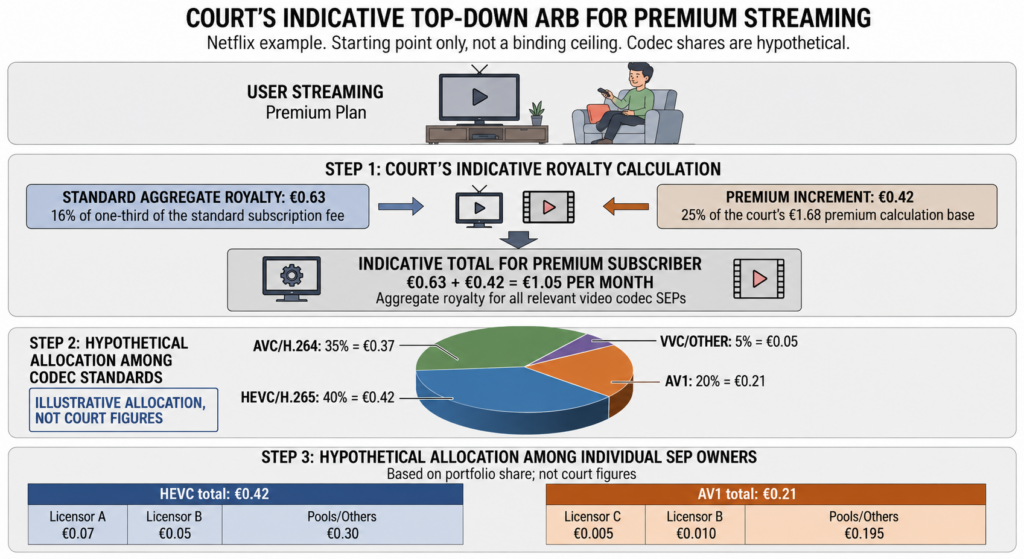
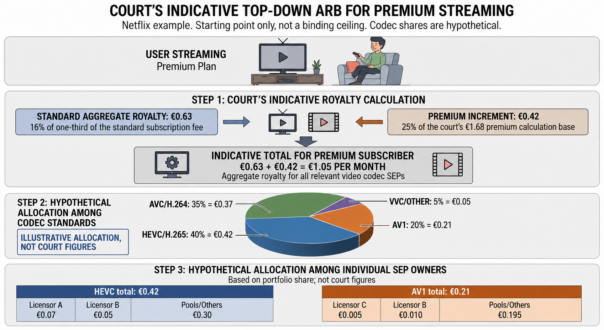
As shown in Figure 1, for a standard Netflix subscription, the court uses one-third of the subscription fee as the royalty calculation base. It then applies an aggregate royalty burden of 16%. Doing the math, one-third of the standard subscription fee × 16% = €0.63 per subscriber per month.
For a premium subscription, the court adds a second component that reflects the additional value associated with higher video quality. It uses one-third of the difference between the standard and premium subscription prices, which the court calculates at €1.68, and applies a 25% aggregate royalty burden. So, €1.68 × 25% = €0.42 per subscriber per month
The standard royalty and premium increment are then combined to equal €1.05 per premium subscriber per month.
To be crystal clear, the €1.05 is the proposed aggregate royalty for all relevant video codec SEPs. It is not the royalty for any individual codec, pool, or patent owner.
The court applies the same method to Disney+. It calculates €0.49 per month for a standard subscriber and adds a €0.35 premium increment, producing a total aggregate royalty of €0.84 per premium subscriber per month.
Allocating the Royalty
The court suggested dividing the aggregate royalty among patent owners based primarily on the relative sizes of their portfolios. It did not allocate specific amounts to individual codecs, pools, or licensors.
The figure below illustrates how this process might work using the €1.05 Netflix premium royalty. In this hypothetical example, 35% is allocated to AVC/H.264, 40% to HEVC/H.265, 20% to AV1, and 5% to VVC and other codecs. This produces €0.37 for AVC, €0.42 for HEVC, €0.21 for AV1, and €0.05 for VVC and other codecs.
Each codec allocation would then be divided among the owners of patents essential to that standard. In the HEVC example, €0.07 goes to Licensor A, €0.05 to Licensor B, and the remaining €0.30 to pools and other patent owners. The €0.21 AV1 allocation is similarly divided among two identified licensors and pools or other patent owners.
All codec percentages and licensor allocations in the figure are hypothetical. They explain how the court’s proposed aggregate royalty might be distributed, but the court did not calculate or endorse them.
What This Means
Note that this ruling doesn’t mean that Netflix or Disney will actually pay the calculated amount. But the guidelines make it clear that the Munich court doesn’t agree that a licensed playback device eliminates the streaming provider’s royalty exposure, or that pool rates do not necessarily limit what bilateral licensors can demand.
The calculations are preliminary and non-binding. Nonetheless, they place a number on a potential cost that streaming services must now consider.
Bibliography
Primary Judicial Source
-
Munich I Regional Court (Landgericht München I), 7th Civil Chamber. “Leitfaden zur FRAND-Einrede” (Guidelines on the FRAND Defense). Prepared by Presiding Judge Oliver Schön, Judge Florian Schweyer, and Judge Katalin Tözsér. August 2026.
Industry Analysis and Media Coverage
-
IAM. “Munich court sets out FRAND framework for video streaming services in new guidelines.” August 2026. Analyzes the 7th Civil Chamber’s top-down valuation methodology, the rejection of patent exhaustion and pool comparables, and the indicative aggregate royalty calculations for Netflix and Disney+. https://www.iam-media.com/article/german-judges-lay-out-approach-video-streaming-sep-licensing-disputes (gated).
-
Klos, Mathieu. “New FRAND guidelines: Munich Court aims to make proceedings more efficient.” JUVE Patent, August 2026. Available at: https://www.juve-patent.com/legal-commentary/new-frand-guidelines-munich-court-aims-to-make-proceedings-more-efficient/
-
Mueller, Florian. “New Munich FRAND guidelines contemplate range from €0.49 to €1.05 per streaming service subscriber as monthly aggregate royalty burden.” ip fray, August 17, 2026. Available at: https://ipfray.com/new-munich-frand-guidelines-contemplate-range-from-e0-49-to-e1-05-per-streaming-service-subscriber-as-monthly-aggregate-royalty-burden/ (registration).
-
Mueller, Florian. “Munich court consolidates FRAND framework for SEP licensing disputes.” ip fray, August 2026. Available at: https://ipfray.com/munich-court-consolidates-frand-framework-for-sep-licensing-disputes/


It’s curious that the court put a value on h264. I will be very interested in the reasoning behind the novel theory that royalties must be paid on expired patents. Perhaps they should add M2V and jpeg to that list.
You lie down with royalty-bearing dogs you get royalty-bearing fleas.
Netflix’s and Disney’s money will be much better spent developing AV1 and AV2. Royalty-free formats and protocols are the only way to go.
The Access Advance and Avanci programs, both of which include AV1 and VP9, would like a word.
I suggest you read https://www.linkedin.com/posts/jan-ozer_when-streaming-platforms-face-licensing-activity-7490035526398369792-3FO4/, or
https://www.linkedin.com/posts/jan-ozer_when-streaming-platforms-face-licensing-activity-7490035526398369792-3FO4/
Jan
Can you show me a single court case in which the validity of those claims has been demonstrated?
If not then no one should believe them.
Why do you gleefully defend a parasitic business model which is unable to demonstrate the validity of its claims, especially when when everything else about the internet is based on royalty-free formats and protocols?
You have a website because of those royalty-free formats and protocols. The only reason there’s an ability to stream anything in the first place is, again, because of royalty-free formats and protocols. The only reason there is an internet is because of royalty-free formats and protocols.
All companies and users have a shared responsibility to uphold its standards. It’s just good business.
As Netflix and Disney have found out, anything less is shortsighted.
Thanks for your comment.
1. Not sure anything is gleeful
2. You don’t get to pick and choose which patents are enforced and which aren’t. Most people couldn’t live without their cell phones (5G) or Wi-Fi, both patented technologies with no complaints. Few could live wihtout video on their smartphones or Smart TVs; not sure why you call the codecs that enable this “internet” technologies that should be free.
3. We pretty much violently disagree, which is fine, but there’s no point in further discourse between us. You won’t convince me and I won’t convince you.
Thanks again for writing it. Jan