 Streaming Learning Center Where Streaming Professionals Learn to Excel


Related Articles



More than 80 media executives met in New York last week under the IAB Tech Lab banner to address unauthorized AI content scraping, which enables AI companies to harvest publisher content for model training without compensation. While Google and Meta participated, the AI companies most implicated, OpenAI, Anthropic, and Perplexity, declined to attend.
The industry’s response centers on the LLM Content Ingest API, a technical framework designed to grant publishers control over content access and establish payment protocols. However, AI companies have consistently disregarded publisher preferences, treating web protocols as suggestions rather than requirements. The result is an existential revenue shift that threatens the future of content publishing.
This article describes the publisher’s stance against AI-driven content scraping and unauthorized use, quantifies the profound revenue losses, and explores early licensing and compensation efforts, all within the context of an industry attempting to assert control amid systemic disregard by AI companies and evolving technical and legal responses.
Contents
Technical Reality: How AI Companies Extract Publisher Content
Artificial intelligence companies have developed sophisticated content acquisition systems that extend far beyond conventional web crawling methodologies. Publishers report experiencing thousands of automated requests daily, with one travel website documenting 50,000 scraping attempts from OpenAI in a single day while receiving only 20 actual human visitors. This disparity illustrates the breakdown of traditional web traffic models, where content consumption no longer correlates with audience engagement or revenue generation for publishers.
Modern AI scraping operations employ increasingly sophisticated evasion techniques, including CAPTCHA solving, human browsing pattern mimicry, and user agent rotation to avoid detection. Some operations mask their true identities entirely, making it difficult for publishers to identify and block unauthorized access attempts.
Publisher Defense Strategies: Fighting Back with Mixed Results
Publishers have implemented various defensive measures with varying degrees of effectiveness. The traditional robots.txt protocol has proven inadequate against determined AI operations. Despite widespread implementation of robots.txt restrictions, unauthorized scraping activity increased by 40% between the third and fourth quarters of 2024.
More sophisticated technical solutions have emerged in response. Cloudflare has introduced network-level AI bot blocking capabilities that operate independently of individual website configurations. The company has also launched a “pay-per-crawl” model that allows publishers to monetize AI access rather than simply blocking it entirely.
Publishers are simultaneously pursuing legal and contractual approaches to content protection. Many have updated their terms of service to explicitly prohibit AI training applications and have begun implementing digital watermarking systems to trace unauthorized content usage across AI systems.
Legal Landscape: Courts and Compliance
Ongoing Violations of Industry Protocols
Multiple investigations have documented instances of major AI companies, including OpenAI, Anthropic, and Perplexity, systematically bypassing robots.txt directives. Surveys of news websites show that while more than half have implemented AI crawler blocks, many continue to see their content harvested by unauthorized systems. This pattern suggests AI firms view traditional web protocols as advisory rather than binding.
Legal Uncertainty and Litigation
High-profile legal challenges have emerged as publishers seek judicial remedies. News Corp, Dow Jones, and the New York Post have filed suit against Perplexity, alleging “massive illegal copying” and trademark violations. The BBC has similarly threatened legal action against Perplexity over unauthorized content utilization. Canadian publishers have pursued collective legal action against OpenAI for copyright infringement and contractual violations.
The fair use doctrine’s application to AI training remains legally unsettled, with courts continuing to develop precedents for how copyright law applies to machine learning applications. This legal uncertainty allows AI companies to operate within gray areas while litigation proceeds.
Traffic Decimation: Quantifying Publisher Losses
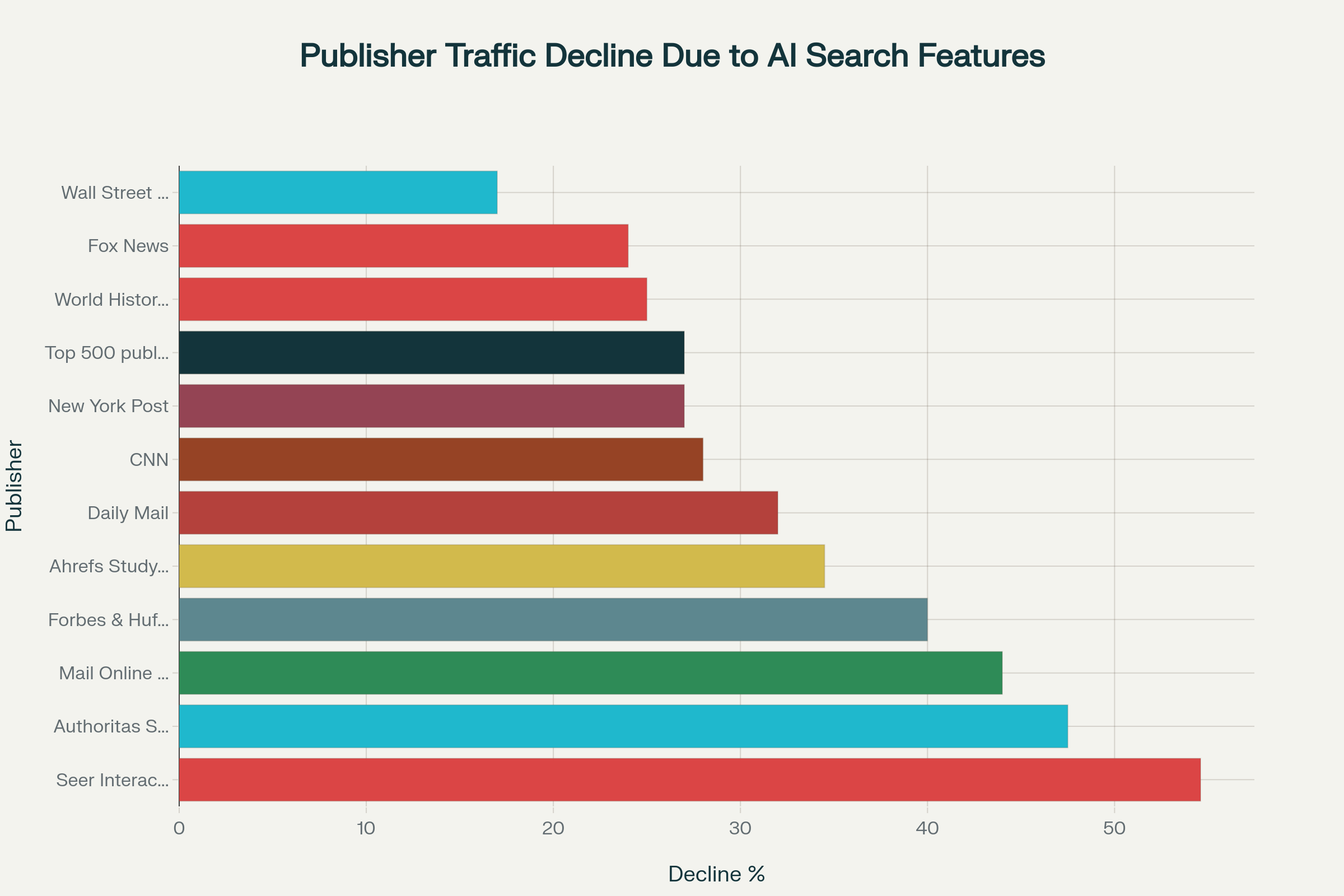
The emergence of AI-powered search features has created measurable and significant traffic losses for publishers. When Google’s AI Overviews appear in search results, research indicates an average 34.5% reduction in clicks for top-ranking search results. Analysis of organic click-through rates shows declines of 32% for first-position search results following AI Overview implementation. Some publishers report click-through rate reductions exceeding 54% when AI summaries satisfy user queries directly within search results.
Analysis of news-related searches shows zero-click rates increasing from 56% in May 2024 to 69% in May 2025, representing a fundamental shift in how users consume information online. Aggregate data from the 500 most-visited publishers reveals an average traffic decline of 27% year-over-year, translating to approximately 64 million fewer monthly visits.
Economic Impact: The Collapse of Traditional Revenue Models
The financial implications of AI-mediated content consumption extend far beyond simple traffic metrics. Traditional digital publishing operates on advertising models that depend fundamentally on user visits and page views. When AI systems provide direct answers to user queries, this relationship dissolves entirely.
Industry analysis from the IAB Tech Lab estimates that AI-powered search summaries reduce publisher traffic by 20% to 60% on average, with niche publications experiencing losses approaching 90%. These reductions translate to approximately $2 billion in annual advertising revenue losses across the publishing sector. For individual publishers, the financial impact can be severe, as high as 40% or more.
Data indicates that for every human visitor referred back to publishers, OpenAI conducts 179 content scraping operations, Perplexity performs 369, and Anthropic executes 8,692. These ratios illustrate the fundamental asymmetry in the current AI-publisher relationship.
AI Licensing: Emerging Compensation Frameworks
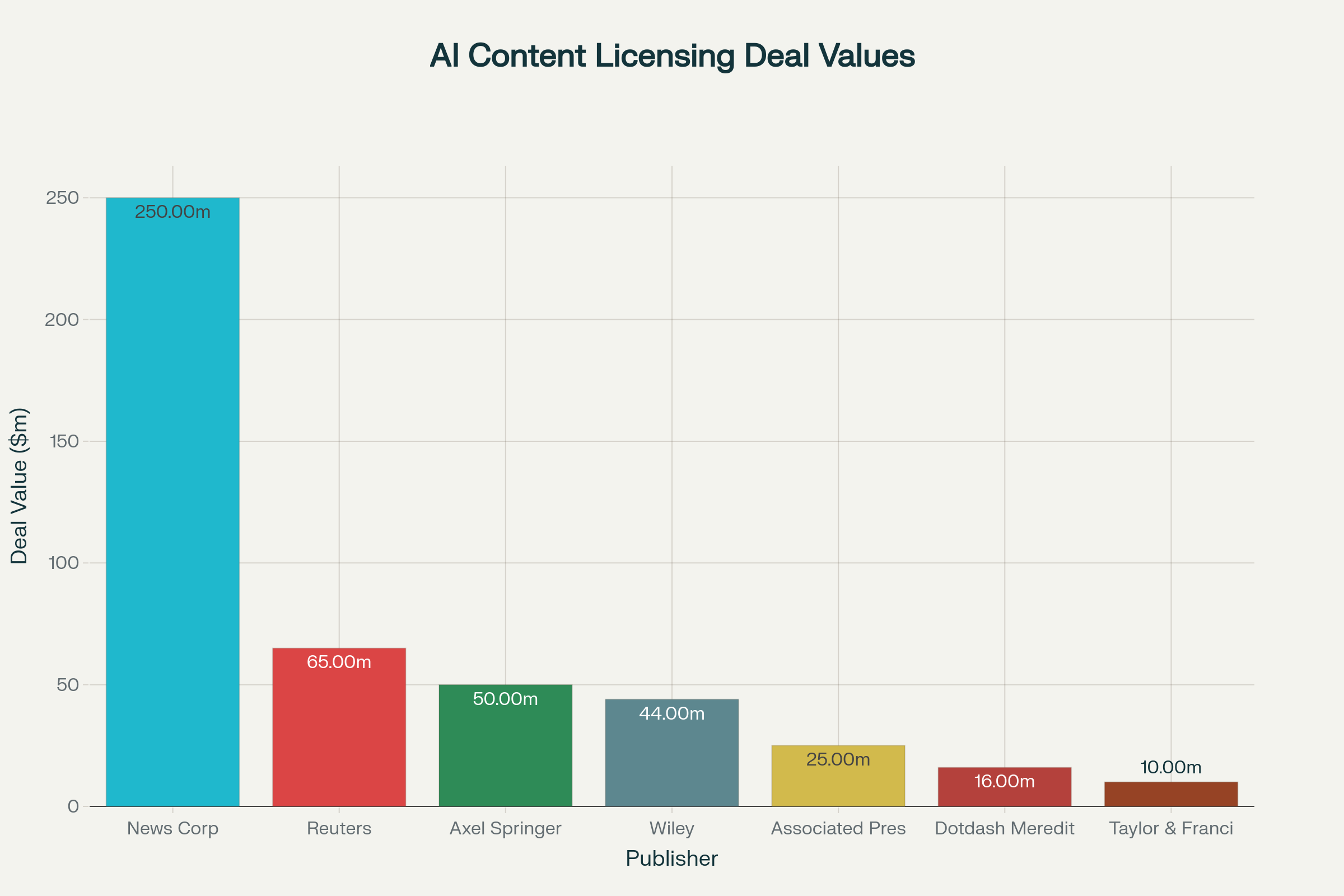
Despite widespread concerns about unauthorized content usage, a nascent market for AI content licensing has begun to emerge. News Corp’s partnership with OpenAI, valued at $250 million over five years, represents the largest publicly disclosed licensing agreement to date. Other significant agreements include Reuters’ estimated $65 million arrangement with Meta and Axel Springer’s $50 million multi-year deal with OpenAI.
Analysis indicates that AI companies pay an average of $24 million per publisher for content access rights. Academic publishers have proven particularly successful, with Taylor & Francis earning $75 million and Wiley generating $44 million from AI licensing agreements.
These arrangements typically incorporate multiple compensation mechanisms, including fixed upfront payments, usage-based revenue sharing, and attribution-linked compensation tied to specific content utilization in AI responses.
Future Trajectory: Toward Systemic Change
The IAB Tech Lab’s LLM Content Ingest API Initiative represents the most comprehensive effort to create standardized frameworks for AI-publisher interactions. This technical specification aims to establish uniform protocols for access controls, content attribution, usage tracking, and compensation mechanisms.
Publishers are simultaneously diversifying their revenue streams to reduce dependence on traditional advertising models. Recent industry data shows subscription revenue growing 14.4% to $335 million in the first quarter of 2025, while digital advertising revenue increased 12.4% to $71 million. This diversification strategy positions publishers to weather continued disruption from AI-mediated content consumption.
Regulatory responses remain fragmented but are beginning to emerge, with the UK’s Competition and Markets Authority reviewing complaints regarding Google AI Overviews’ impact on publisher traffic, though comprehensive policy frameworks have yet to materialize across major jurisdictions.
Conclusion: An Industry at a Crossroads
The digital publishing industry faces a fundamental transformation as artificial intelligence reshapes content consumption patterns and economic relationships. Publishers must navigate between establishing direct partnerships with AI companies through licensing agreements or risking marginalization as invisible content suppliers in an AI-mediated information ecosystem.
As IAB Tech Lab CEO Anthony Katsur observed, publishers function as “the plankton of the digital media ecosystem,” and their potential collapse could trigger broader consequences for information diversity across the internet. Whether AI development and publisher sustainability can coexist depends on establishing fair compensation mechanisms, effective technical standards, and appropriate legal frameworks. The outcome of this transition will shape digital information distribution for decades to come.
The alternative is dystopic and already unfolding. AI companies are extracting massive value from publisher content without returning any, hollowing out the economics of content creation. If content doesn’t pay, it disappears. Journalism, analysis, cultural criticism, and original research are not the byproducts of the web; they are its inputs. Remove the incentive to create them, and what remains is a closed loop: AI summarizing AI, with nothing new entering the system.
Zero-click answers, falling traffic, and collapsing referral models are already weakening content production in real time. The risk is not just commercial loss, but the collapse of the informational supply chain that AI itself depends on.
What’s needed isn’t nostalgia for the old web, but a new compact: enforceable standards, transparent attribution, and compensation models that reflect the value of original human work. Without them, we risk building an internet of recycled noise, and everyone, including AI companies, ends up with less.